
David Suarez is accused of funding ads targeting residents
If anybody has any lingering doubts that Miami Beach has fully committed itself to becoming America’s most aggressively pro-Israel municipal government — to the point that it could violate the rights of its own residents — they can put those to bed now.
Because it looks like the city’s support of a foreign government has escalated from symbolic resolutions and performative solidarity trips into something much uglier: a sitting city commissioner allegedly paying for roaming billboard trucks targeting his own constituents — by name.
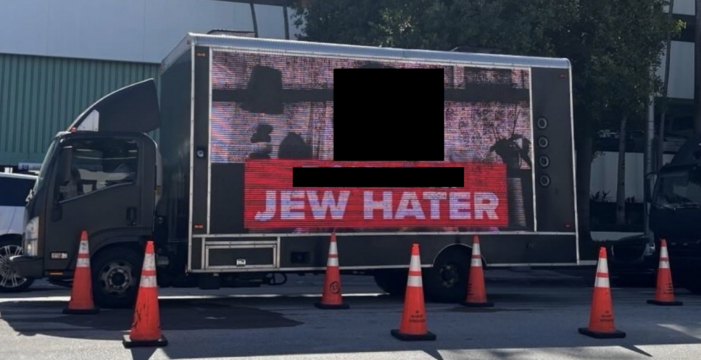
According to documents filed in federal court and announced publicly Wednesday at a press conference, Commissioner David Suarez allegedly spent $4,000 on three billboard trucks that circled during Art Basel last December displaying videos and images attacking Jewish Voice for Peace South Florida, a nonprofit that mobilizes U.S. Jews to stand in solidarity with the Palestinian freedom struggle and advocates for the end of U.S. military aid to Israel.
And not just the organization.
The trucks reportedly featured enlarged photos of two Jewish Miami Beach residents alongside the words “Jew Hater,” plus their first names and last initials.
Welcome to Miami Beach, where the tourism slogan may soon need updating from “Sun and Fun” to “Enemies List on Wheels.”
Read related: In Miami Beach, a Facebook comment could mean police knock at your door
“The Commissioner has targeted me and called me a Jew hater because I differ with his views on Israel, because my Jewish 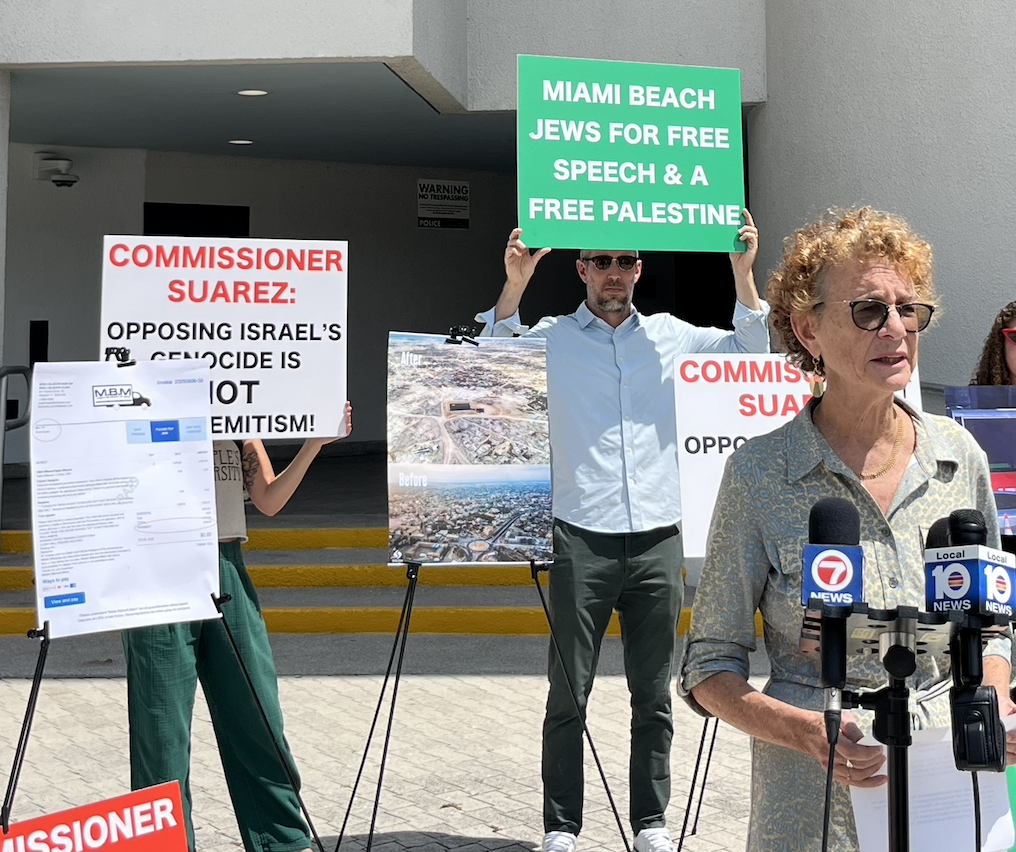 learning taught me that we have an obligation to fight injustice whenever and wherever it exists, and because I stand with Palestinians and millions across the globe, including large numbers of Jews, who demand justice for the Palestinian people and an end to Israel’s genocide,” said Donna Nevel, a community psychologist, educator and writer who has been involved in fighting for Palestinian human rights for decades — and whose mug was featured on the mobile billboard.
Nevel grew up in Miami Beach. She attended Hebrew Academy and had her Bat Mitzvah at Temple Beth Sholom. Her father was deeply involved in the Jewish community and she grew up hearing the stories of Holocaust survivors.
“That history was etched into my consciousness,” Nevel said at the press conference. “That Commissioner Suarez has the audacity to accuse those of us calling for justice for the Palestinian people of being antisemitic makes a complete mockery of that history.”
The group discovered the invoice with the commissioner’s name on it after they subpoenaed the records of the mobile truck company, which was circulating where the Jewish Voice for Peace activists had organized to hand out leaflets. The lawsuit is in the discovery phase.
“When we saw the billboards, we didn’t know Commissioner Suarez was the one who created and paid for them, but having watched his destructive, taunting behavior in City Commission meetings over and over again, I can’t say I was shocked to learn it was him — though, even for him, it was extreme,” Nevel said.
“We didn’t think as a public official he would stoop that low,” she told Ladra later.
“The unethical actions of Commissioner David Suarez threaten the safety of Jewish and non-Jewish activists in Miami Beach,” said Hayley Margolis, another member of Jewish Voice for Peace, which in September filed a lawsuit against the city arguing that it violated the group’s First Amendment rights by creating and enforcing restrictions designed to silence their pro-Palestinian, anti-Zionist protests..
“His behavior is part of a pattern of the Mayor and the Miami Beach City Commission attacking members of the Jewish 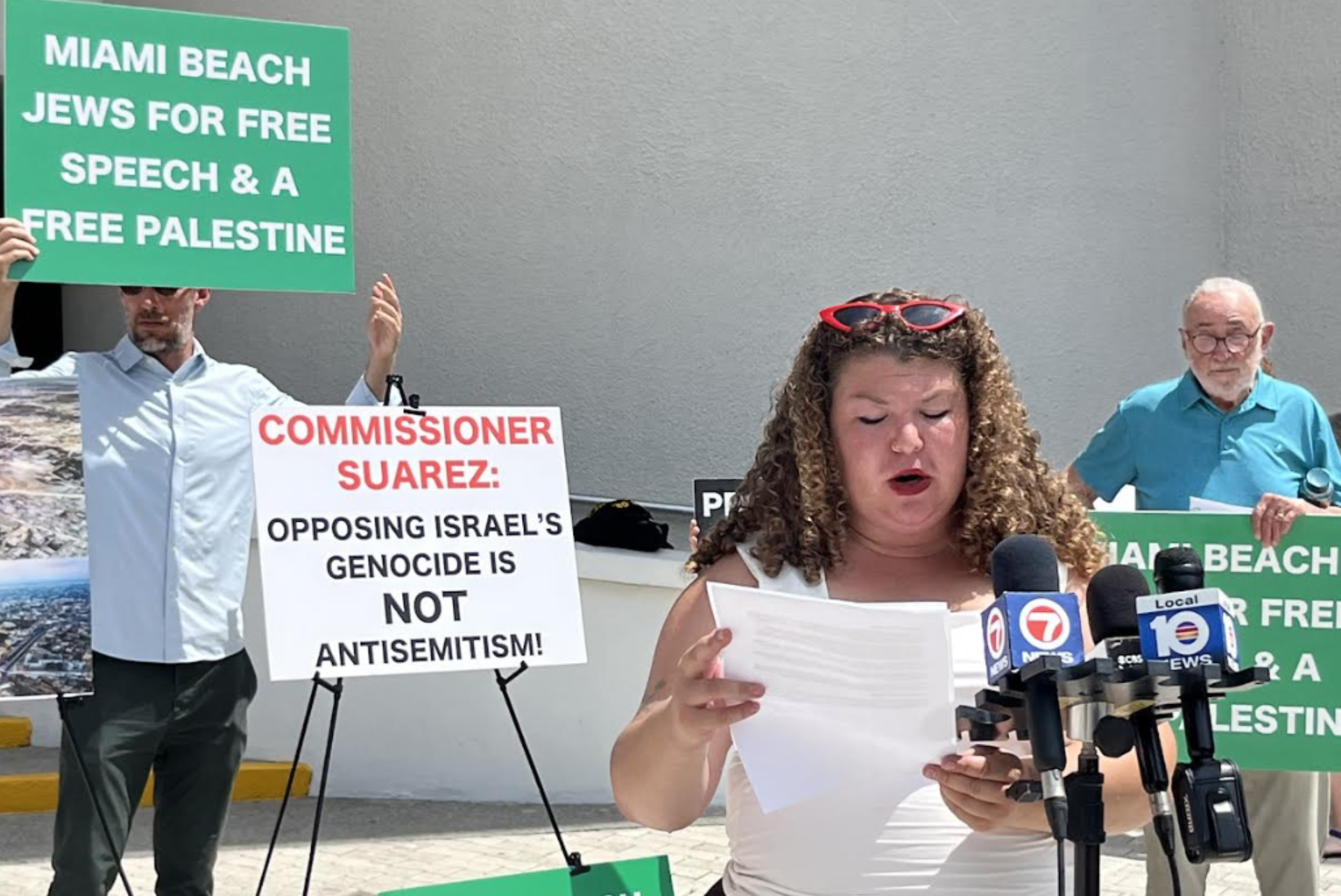 community and others who speak up for justice for the Palestinian people,” Margolis said. ” These outrageous billboards demonizing Jewish members of our community are not the first example of the City’s overstepping its authority, though it is a particularly egregious example.”
Ken Burns, a retired physician and member of the organization said Suarez was known as a bully. But that this action was far worse because of its intended impact.
“By hiring the three billboard trucks, David Suarez was attempting to silence and target members of the Miami Beach community for political and retaliatory reasons,” Burns said. “This involved intimidation and harassment, wanting constituents to become fearful of negative consequences if they spoke publicly, criticized officials, or exercised their free speech rights. In fact, he was attempting to suppress protected speech.
“What he did is an abuse of public office. He created a video that defamed two people as well as a Jewish social justice organization,” Burns said. “This was abuse of a public elected position for an improper purpose rather than for the public good.”
Activists demanded Suarez resign from the commission.
Said Margolis: “Given the seriousness of his misconduct and his intentional behavior designed to defame, harass, and intimidate, we believe that his continued presence as a Miami Beach commissioner is harmful to the community and that he no longer has the public’s confidence and cannot govern effectively.”
In an email, Suarez declined to give Political Cortadito a comment. But in an email to The Intercept, a non-profit journalism organization that fights corruption and injustice, Suarez doubled down. “You can use this response, only in its entirety,” Suarez 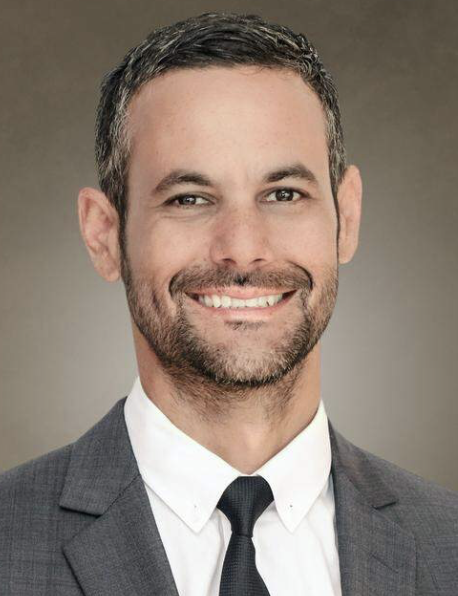 wrote, “as a jew, I can spot a jew hater a mile away.”
As a Jew, he should also know that the word is a proper noun and should always be capitalized. Maybe he is the hater.
The allegations landed with particular force because the city has spent the last two years loudly presenting itself as a zero-tolerance jurisdiction when it comes to antisemitism. Mayor Steven Meiner and several commissioners have aggressively aligned themselves with Israel following Oct. 7 — approving Israel bond investments, sending public resources and personnel abroad, and repeatedly framing local criticism of Israeli policy as dangerous extremism.
But critics say something else has happened along the way: Miami Beach’s political culture has become increasingly hostile toward dissent itself.
Read related: Miami Beach Mayor Steven Meiner defends calling the cops on a critic
That perception exploded nationally after the now-infamous police visit to activist Raquel Pacheco, a military veteran, soccer mom and two-time candidate to the city commission who was questioned at her home by Miami Beach police after criticizing Meiner online over Israel and Gaza. The video 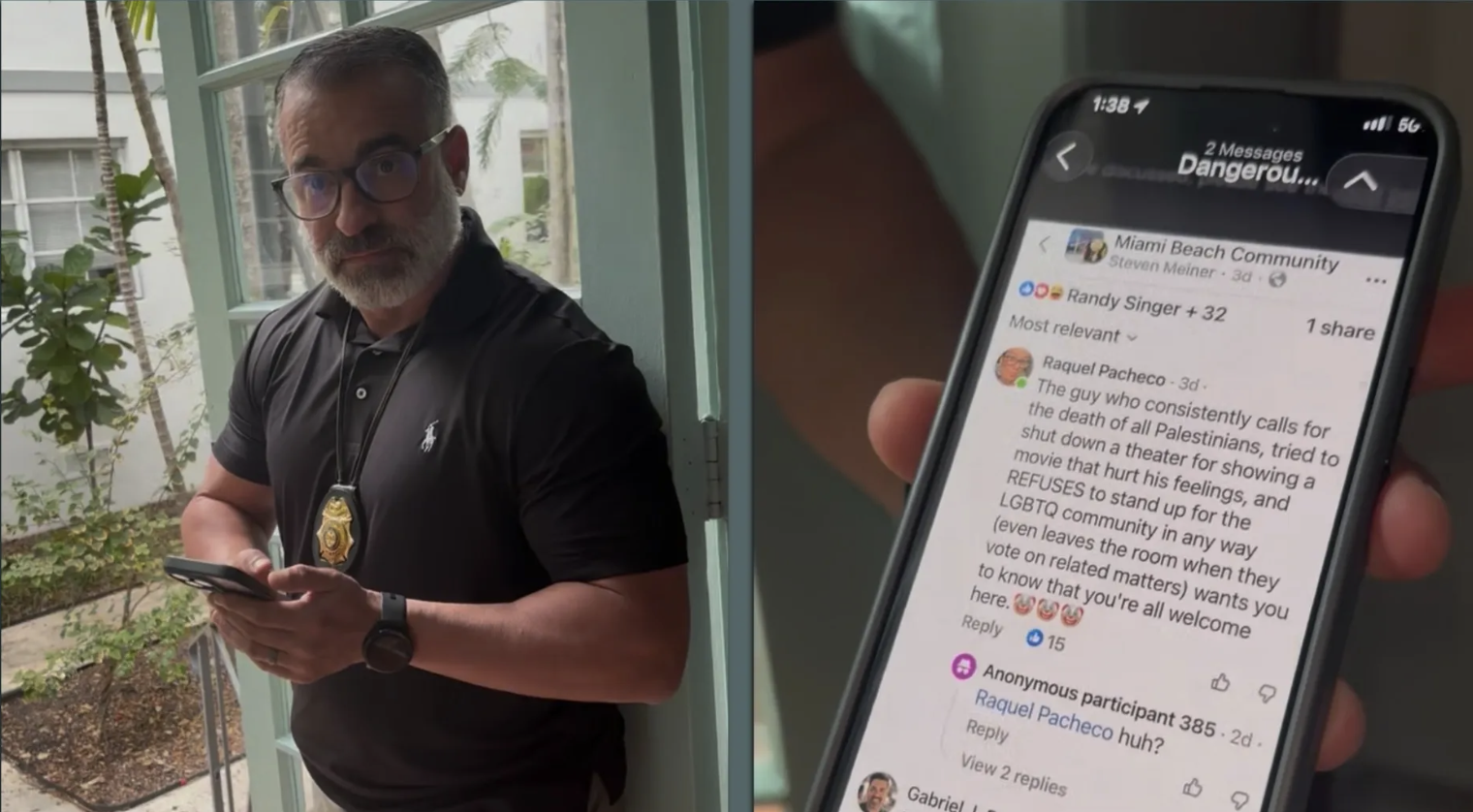 of officers standing at her door while she incredulously asked, “This is America, right?” ricocheted across social media and transformed Miami Beach into a free-speech cautionary tale almost overnight.
Meiner and the cops defended their Gestapo actions by saying that the comment could have incited someone to commit violence. But it seems to Ladra that billboard trucks branding residents “Jew haters” during one of the city’s largest international events would be far more likely to incite violence than a Facebook comment.
“I remember going out and thinking, oh my God, what if someone sees me and says ‘That’s the Jew hater,'” Donna Nevel told Political Cortadito after the press conference.
The irony here is impossible to ignore. The people being targeted are themselves Jewish residents and members of Jewish Voice for Peace, an organization sharply critical of Israel’s war in Gaza and supportive of Palestinian rights. The group argues that Miami Beach officials have increasingly conflated criticism of Israeli policy with antisemitism itself — a distinction civil-liberties groups across the country have warned governments not to erase.
One of the residents displayed on the trucks is reportedly an attorney involved in ongoing litigation against the city challenging restrictions on protest activity related to Gaza demonstrations.
Which means this entire mess now carries the aroma not just of political retaliation, but potentially government-backed intimidation.
At Wednesday’s press conference outside City Hall, speakers accused Suarez of weaponizing public office to target political 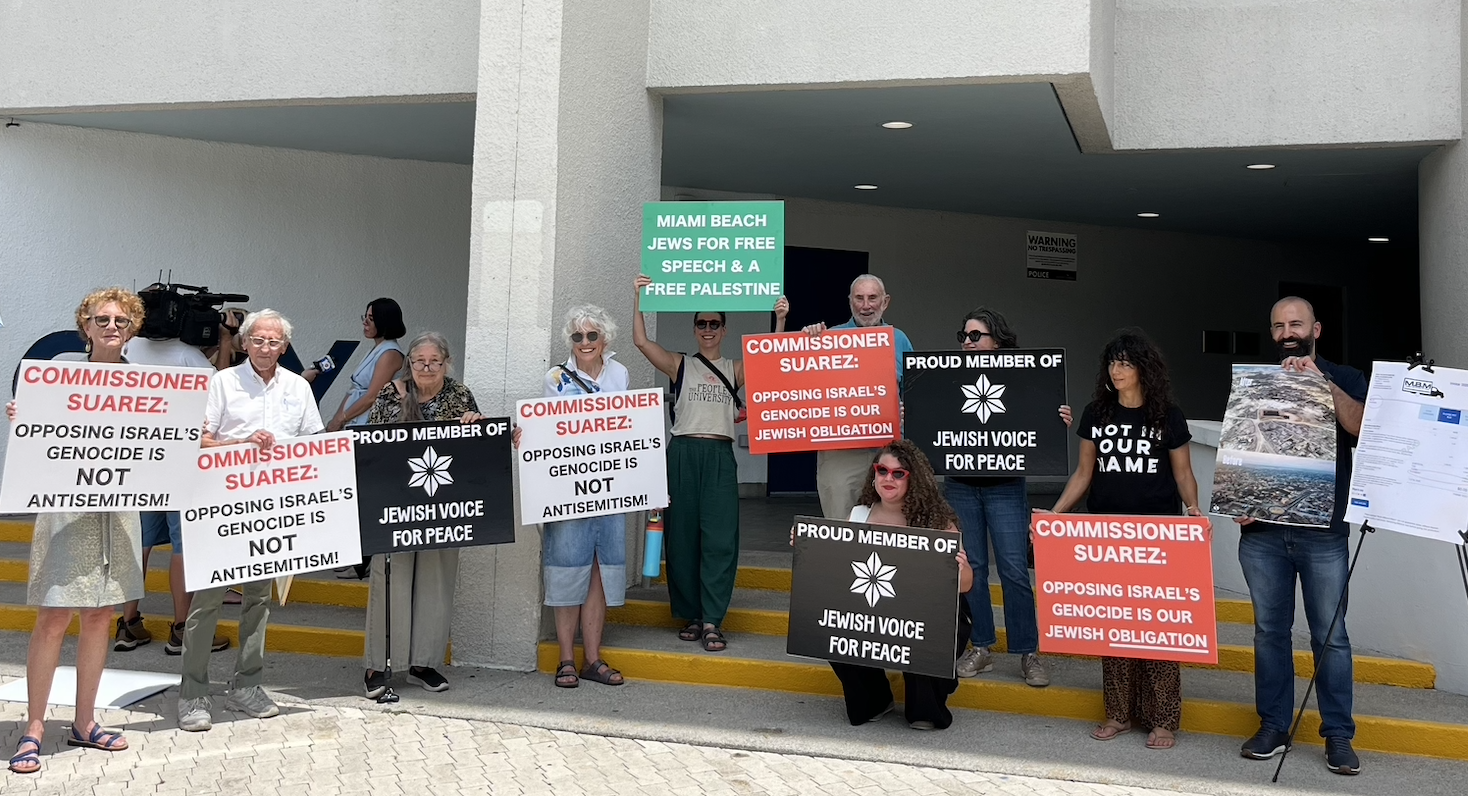 opponents and inflame tensions in a city already boiling over with ideological division. They argued the trucks placed residents at risk by publicly labeling them antisemitic in a climate where accusations involving Jews, Israel and Gaza have become emotionally and politically combustible.
Because once elected officials start publicly branding constituents enemies — literally driving their faces around town on LED trucks — politics stops looking democratic and starts looking theatrical, punitive and deeply personal. Even authoritative.
Suarez — who had to temporarily surrender more than a dozen guns and his concealed weapons permit to police in 2020 after his young child was seen “in close proximity” to the weapons while in his care — has not exactly cultivated a reputation for restraint at commission meetings. Anyone who has watched the increasingly chaotic Israel-Palestine clashes at City Hall knows Miami Beach government meetings now often resemble ideological cage matches with parliamentary procedure sprinkled on top.
Read related: Miami-Dade still deep in Israel bonds despite budget woes — and genocide
But this takes the conflict out of chambers and into the streets.
And it further cements Miami Beach’s growing national image: not merely as a city strongly supportive of Israel, but as a government increasingly comfortable using institutional power, public pressure and political spectacle against critics. The mayor consistently shuts off the mic during public meetings for Palestinian defenders and tried to evict O Cinema when they screened the Oscar-winning documentary “No Other Land,” which covers Palestinian displacement in the West Bank,
Supporters of the city’s approach insist officials are responding to genuine fears of rising antisemitism and protecting Jewish residents at a volatile moment globally.
Critics counter that Miami Beach has crossed into something more troubling — where public officials seem unable or unwilling to distinguish between hatred toward Jews and criticism of a foreign government’s military actions.
That distinction matters legally. It matters politically. And it certainly matters when police are knocking on doors and elected officials are allegedly funding rolling digital scarlet letters.
Meanwhile, the rest of the country watches Miami Beach with a mixture of fascination and disbelief as America’s most glamorous little beach town continues its transformation into the nation’s weirdest geopolitical battleground.
This kind of independent, government watchdog reporting is crucial to transparency and democracy. And more so every day. Help shine a light on the darker corners of our community with a contribution to Political Cortadito. Click here. Ladra thanks you for your support.

Miami Beach commissioner funded mobile ‘Jew hater’ billboard trucks added by Ladra on
View all posts by Ladra →
