
There was a time in America when criticizing an elected official on Facebook earned you an argument in the comments. Maybe a few unfollows.
Now, in Miami Beach, it earns you a visit from the cops.
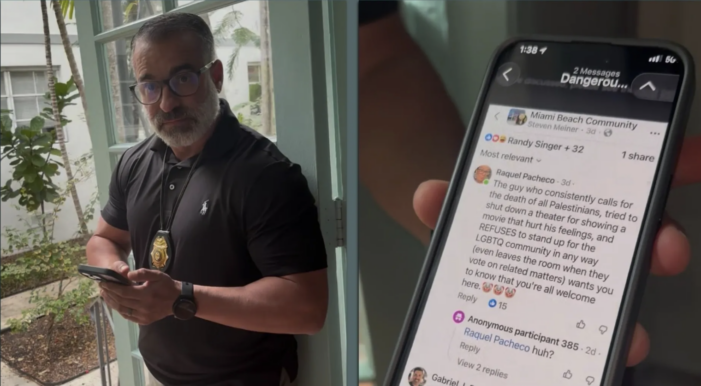
On Monday, Raquel Pacheco — a military veteran, soccer mom, two-time candidate for city commission who also ran for state senate who is well known in local political circles — opened her front door to two Miami Beach police detectives who wanted to ask her about something that was, apparently, dangerous.
Not a weapon. Not a threat. Not a crime.
A Facebook comment.
Pacheco had responded to a post by Miami Beach Mayor Steven Meiner, who had shared a glossy photo proclaiming the city a 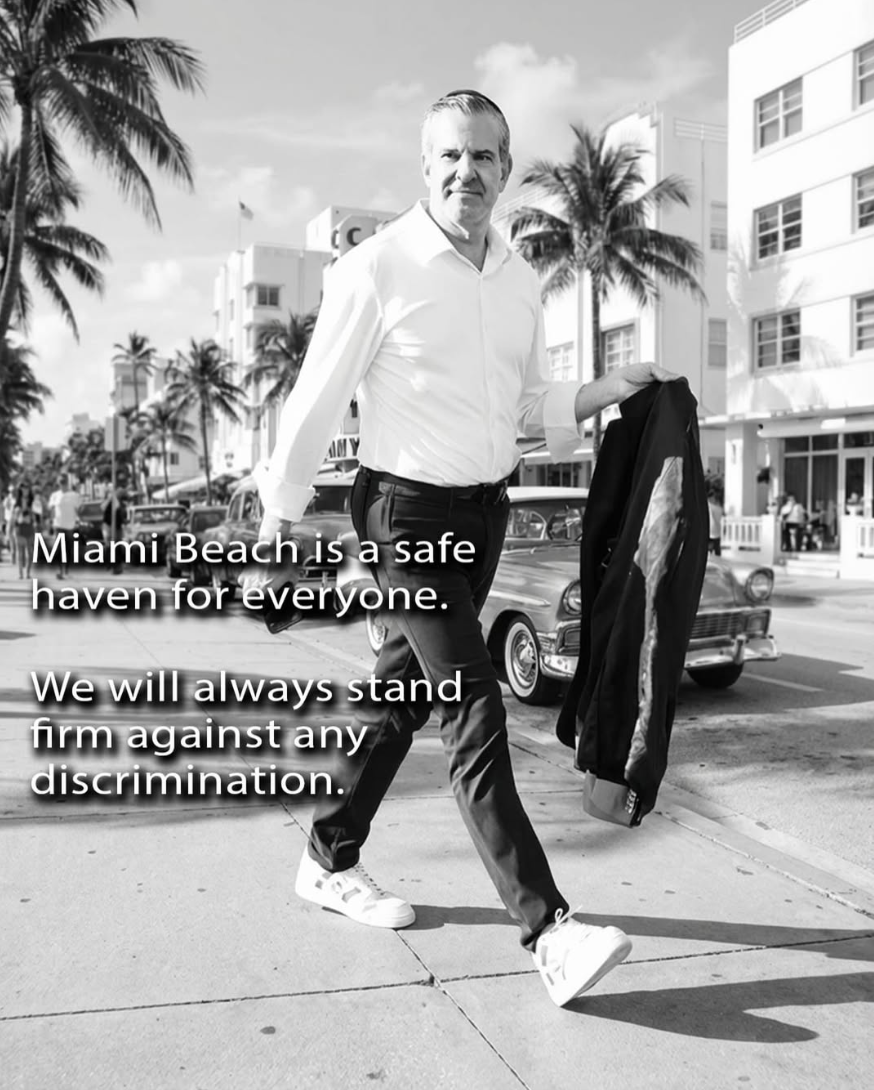 “safe haven for everyone.” In the text, he said, “Our city is consistently ranked by a broad spectrum of groups as being the most tolerant in the nation. By contrast, certain places like New York City are intentionally removing protections against select groups, including promoting boycotts of Israeli/Jewish businesses. Discrimination and hate against Jewish people never ends with the Jewish people. We will always stand firm against any discrimination.”
Pacheco called the BS. She criticized the mayor’s political positions, including his statements on Israel, his efforts to shut down a theater over a Palestinian film he disliked, and his refusal to support LGBTQ protections. Meiner’s “stand” against discrimination basically depends on who you are and how you feel, mostly about Israel and the genocide in Gaza. And Pacheco said as much.
Read related: Incumbent Mayor Steve Meiner holds on in Miami Beach — but just barely
“The guy who consistently calls for the death of all Palestinians, tried to shut down a theater for showing a movie that hurt his feelings and REFUSES to stand up for the LGBTQ community in any way (even leaves the room when they vote on related matters) wants you to know that you’re all welcome here,” she commented on his post. Then used three clown emojis.
And she wasn’t the only one to call him a hypocrite. Did others who made comments on his post also get a visit from the police? 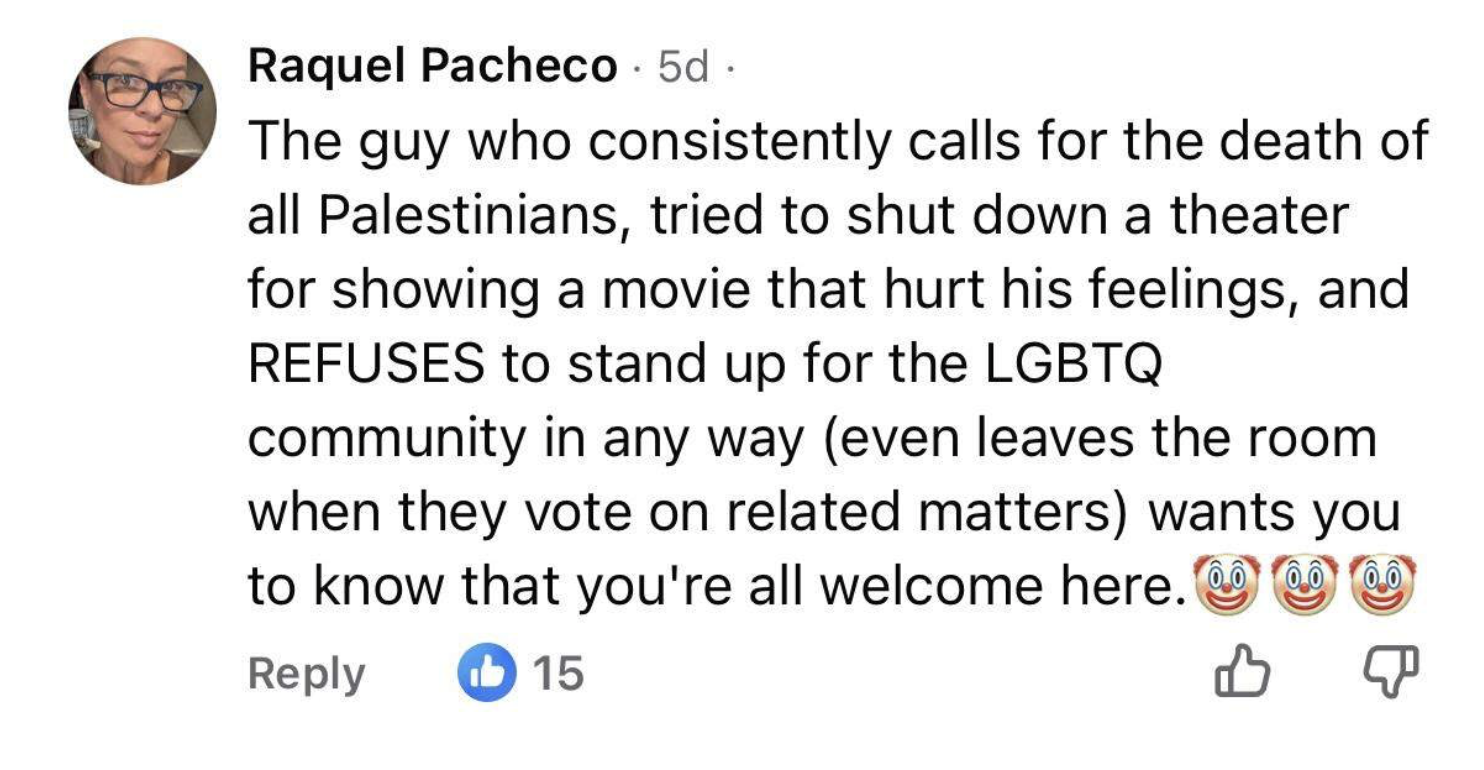 Or is that reserved for someone who criticizes the mayor frequently?
Was Pacheco’s comment sharp? Yes. Threatening? No. Protected speech? Absolutely.
Still, police went to her home to investigate (read: intimidate).
Pacheco did what every American should be doing right now when confronted by police: She started recording with her phone. She asked the question every American should be asking right now if approached by police: “Am I being charged with a crime?”
No, they told her in the video that is now making news around the world. They are just there to “investigate a statement” she made on Facebook, asking her to confirm if that is her profile and showing it to her on a cellphone. “Is that your account?”
According to Miami Beach Police Officer Christopher Bess, a department spokesman, the department “was made aware of a social media post containing potentially inflammatory commentary referencing a Miami Beach elected official. In light of recent national concerns regarding antisemitism, and out of an abundance of caution, the Department assessed the post for any potential safety implications.”
Ladra had asked him how the department had become aware, but he didn’t answer that question. He did tell the Miami Herald that the mayor’s office was the one that alerted the police to the comment. In other words, the mayor. He may try to throw some staffer under the bus, but this has his fingerprints all over the place.
“As a precautionary measure,” Bess continued in an email to Political Cortadito, “Intelligence Unit detectives conducted a brief, consensual encounter to ensure there was no immediate threat to the safety of the elected official or the community. The encounter was conducted in a professional manner and concluded without incident.
“The Miami Beach Police Department remains committed to safeguarding public officials, residents, and visitors, while also respecting constitutional rights, including freedom of expression.”
Pacheco says it didn’t feel that way. The detectives were in plain clothes and an unmarked car. They knocked for a while before identifying themselves. “I didn’t know who they were,” Pacheco told Ladra, adding that she wondered for a second if it was ICE.
And what does consensual even mean in this context? That she opened the door? Would they have rammed it if she hadn’t? A “consensual encounter!” Really? I’d like to see that in every police report from now on.
Read related: Miami Beach mayor wants more ‘decorum’ among city officials, residents
The video is worth watching because the detectives do sound a little intimidating. “We’re just trying to prevent somebody else getting agitated or, or, or agreeing with the statement,” one detective says, clearly choking on his own words. They just want to  make sure nobody agrees? That’s a police matter now? And how does a visit to Pacheco’s home accomplish that?
“I suggest you refrain from posting things like that,” the detective actually says.
Let that sink in. Police now feel authorized to show up at your house — not because you threatened violence, but because your words might make other people agree with you.
This is no longer policing crime. This is policing thought.
Pacheco refused to answer questions without a lawyer. Good instinct. The officers pressed on anyway. They said they were not saying that her statement was true or false. Just that it referenced an elected official. Just that there were “heightened concerns.” Just that they were acting “out of an abundance of caution.”
Caution, apparently, about democracy.
The Miami Beach Police Department insists this was a “brief, consensual encounter.” That they were merely ensuring “no immediate threat.” That they remain committed to constitutional rights, including freedom of expression.
And yet — they showed up at a private citizen’s home to question her about a political opinion posted online.
That is the chilling part. Not what they said afterward in a press release. What they did before it.
Read related: Monica Matteo-Salinas coasts to big win in Miami Beach commission runoff
Miami Beach spokesperson Melissa Berthier did not respond to a request for information from Political Cortadito. But Mayor Meiner, for his part, says it’s a police matter.
The guy who is the self-proclaimed law and order mayor, who has consistently shut off the mic for Palestinian defenders and 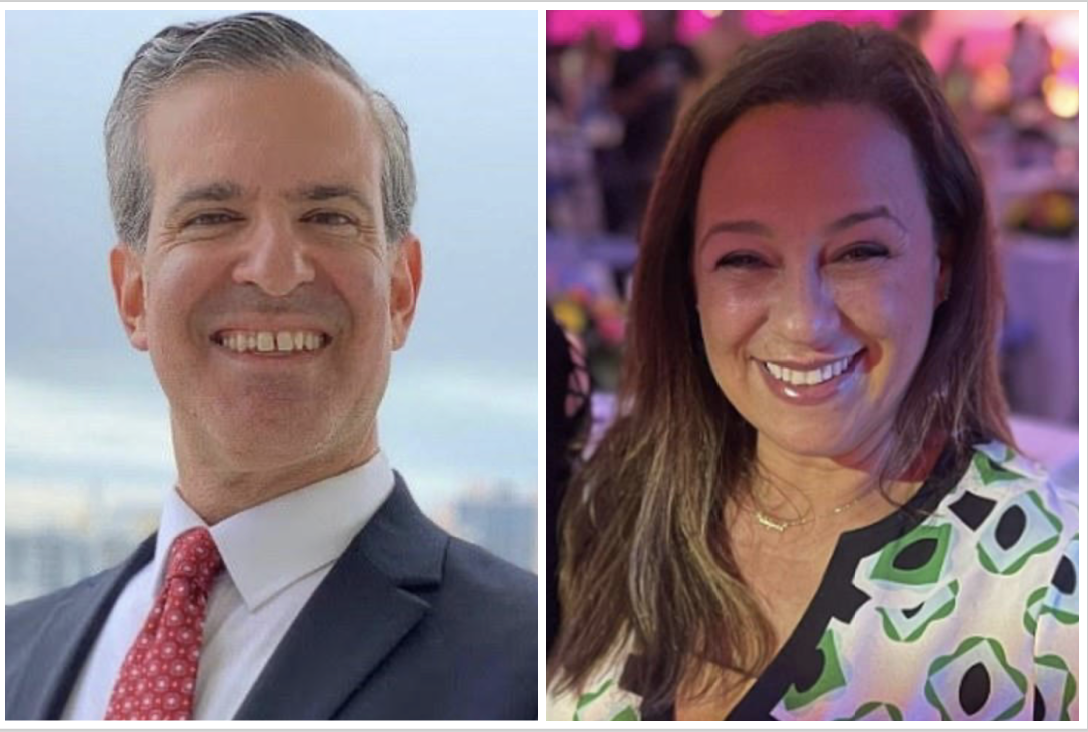 tried to evict O Cinema when they screened the Oscar-winning documentary “No Other Land,” which covers Palestinian displacement in the West Bank, the guy who consistently wears a MBPD jacket around town — and who reportedly has a security or protection detail he doesn’t really need — says it’s a police matter. A police matter that originated in his office?
Meiner also says the comment contained inflammatory and false language that “warranted follow-up.” In other words: when citizens criticize him too harshly, law enforcement might come calling.
Welcome to the new civics lesson: If you praise power, you are left alone. If you challenge power, there may be a knock at the door.
Pacheco describes the moment with clarity. “Freedom of speech as I know it died at my front step,” she told CBS 4 Miami. “And that’s an incredibly sad, sad thing.”
It’s also an egregious abuse of power. A scare tactic. And a pattern.
Jewish Voice for Peace filed a lawsuit against Miami Beach in September, alleging the city and officials violated its First Amendment rights by passing an unconstitutional anti-protest ordinance after they protested Israel’s actions in Gaza during Art Basel 2023. The suit claims police illegally ordered protesters from public sidewalks and that a new ordinance grants excessive discretion to silence future demonstrations.
In Pacheco’s case, it could also be a move to maybe stop her from having any political pull.
“They’re trying to paint me as some kind of danger to the Jewish community,” she said. “And it’s an abuse of taxpayer resources. I’m sure none of these officers signed up to be Facebook patrol.
“These people took an oath to the constitution. And he completely disregards their duty when he uses them this way,” Pacheco said, adding that it’s bad publicity for the Beach. “Miami Beach is a safe place for Jewish people. Why is 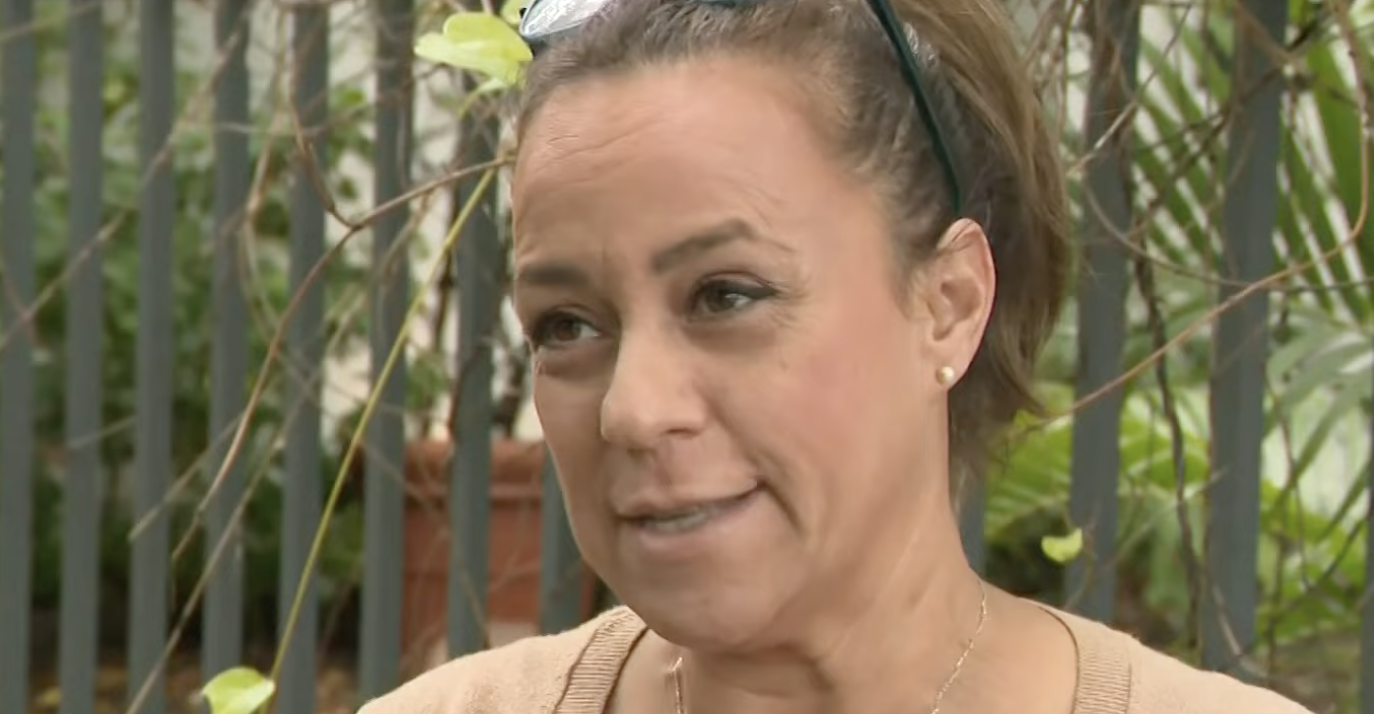 he making it seem like we have to be a police state?
“This is the kind of publicity he wants for his city? He’s a disgrace. He should resign.”
She has now hired an attorney, Miriam Haskell, the executive director of the Community Justice Project, which usually deals with immigration cases. They’ve filed public records requests. Pacheco wants to know who complained, who ordered the visit, and how exactly a Facebook comment turned into a police investigation.
And she’s right to ask. Because if this can happen to a veteran, a former candidate, a well-known local activist — imagine what can happen to a quiet resident who simply posts the wrong opinion on the wrong day.
This is how authoritarianism grows. Not with tanks in the streets. But with polite officers at the door. With phrases like “out of an abundance of caution.” With officials who say they support free speech — right after authorizing a visit about speech they dislike.
In Miami Beach, the sand is still white. The water still blue. The tourism slogans still cheerful.
But somewhere in a quiet neighborhood, a woman learned that a Facebook comment can summon law enforcement.
If you like what you read on Political Cortadito, please consider making a contribution to support the independent, government watchdog journalism on this website. Thank you!

In Miami Beach, a Facebook comment could mean police knock at your door added by Ladra on
View all posts by Ladra →
