

The City of Miami may be about to discover whether residents hate construction fences more than they hate billboards.
On Thursday, commissioners will consider a one-year pilot program that would allow commercial advertising on construction site fencing throughout parts of the city’s Urban Core.
The pitch is simple enough: Construction fences are ugly. They attract graffiti. They create visual blight. Why not cover them with advertising, keep them clean, and generate revenue for city quality-of-life programs?
What could possibly go wrong?
Actually, don’t answer that. This is Miami.
The proposal would allow static advertisements — not digital signs — on construction fencing surrounding active development sites. The signs couldn’t be illuminated, couldn’t face state highways, couldn’t make noise, and would disappear once construction ends.

Supporters say it’s a creative way to clean up construction zones while generating money for graffiti removal and other neighborhood improvements.
Critics are likely to hear something else.
Billboards.
Again.
Because downtown residents haven’t exactly forgotten the city’s last sign war.
Read related: Commissioner Miguel Gabela is swing vote on Miami’s LED billboard rollback
That battle culminated with the giant waterfront billboard outside the Pérez Art Museum Miami, a saga that included lawsuits, public outrage, commission votes, legal settlements, neighborhood opposition, and enough political drama to qualify as its own Netflix series.
For those keeping score at home, the city first approved giant digital billboards, then sued over one, then repealed the ordinance that allowed them, then negotiated to keep one standing anyway.
Consistency has never been Miami’s strongest brand.
To be fair, this proposal is very different. No giant LED screens. No flashing lights. No Times Square-on-the-Bay ambitions.
Just large printed advertisements wrapped around construction fences.
Still, residents who fought the waterfront signs may see this as the camel’s nose under the tent flap. Today it’s construction fencing. Tomorrow it’s another “limited pilot program.” Then another exception. Then another special circumstance.
And before long somebody’s pitching a 40-foot illuminated margarita ad overlooking Biscayne Boulevard.
Again.
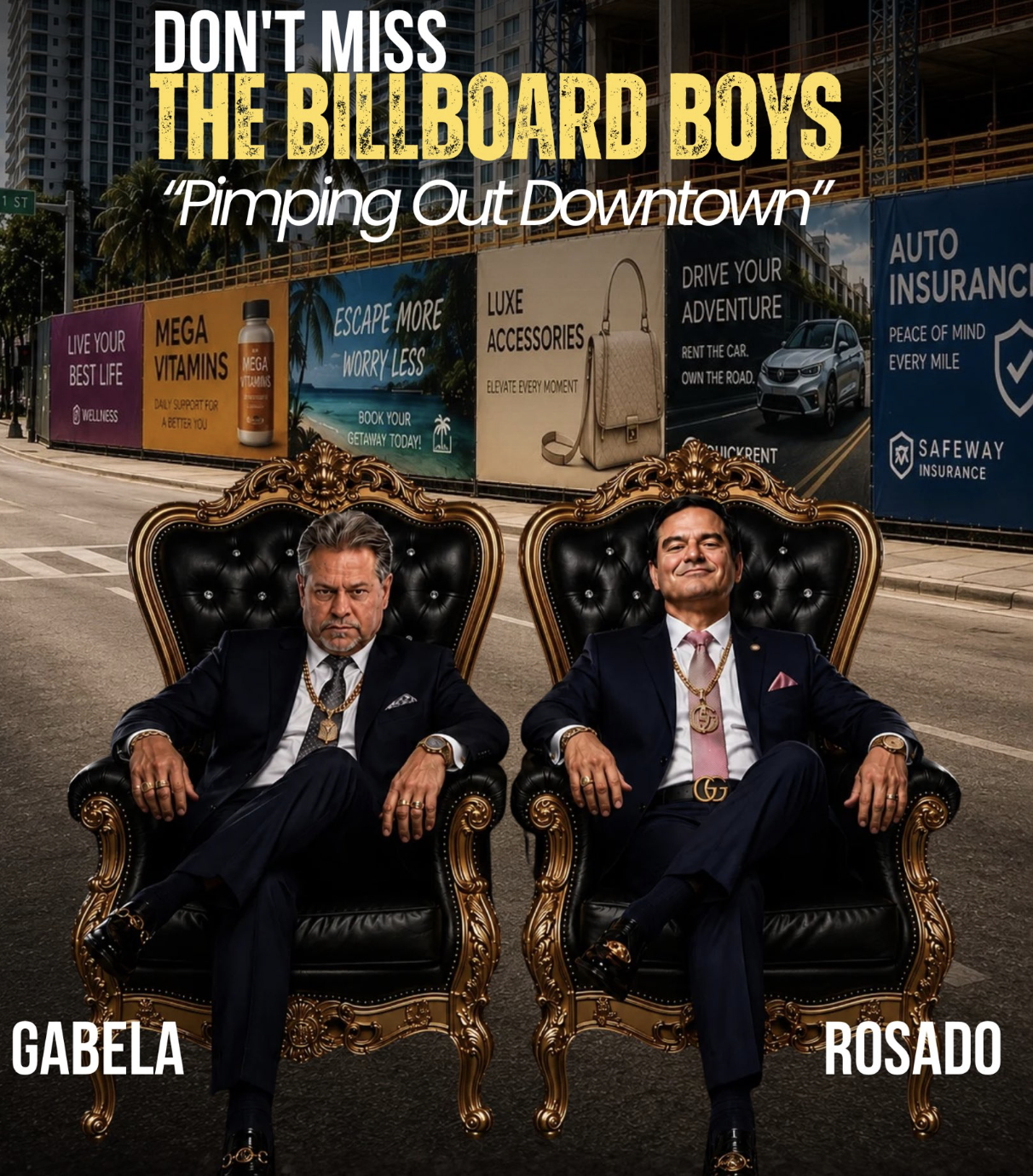 James Torres, the president of the Downtown Neighbors Association and one of the people who most fought the digital billboards, says this is just another way to add “visual pollution” to the downtown and calls the sponsors — Commissioners Miguel Gabela and Ralph Rosado — the “billboard boys,” in his social media memes, which are pretty entertaining. He says they want to “pimp out downtown’s construction sites for profit.
“Funny how the ‘Billboard Boys’ visual pollution scheme doesn’t affect their own neighborhoods,” Torres posted on X, formerly known as Twitter. “Then again, neither do the DDA taxes. Apparently Downtown is where all the bad ideas get tested first.”
Read related: Miami repeals law allowing massive billboards despite threat of lawsuit
One detail that may attract particular attention is that the ordinance designates a single company, New York City-based Del Mastro Outdoor, LLC — which does these things in New York, Boston and San Francisco — as the exclusive operator of the pilot program for its one-year duration.
Nothing gets Ladra more excited than the words “sole source.” Well, maybe “emergency procurement.” But “sole source” is close.
The city would receive 15 percent of gross advertising revenue from participating sites, with officials saying the money could help fund quality-of-life initiatives and graffiti cleanup efforts.
Which means commissioners are about to weigh a very Miami question: Is a billboard still a billboard if it’s covering something uglier?
Thursday’s debate should be interesting. Especially because everyone agrees construction fencing is ugly.
The fight will be over whether advertising is an improvement — or just a prettier version of the same thing.
The Miami City Commission meeting starts at 9:30 a.m. at City Hall, 3500 Pan American Drive, and can be seen live on the city’s website and also on the city’s YouTube page.
This kind of independent, government watchdog reporting is crucial to transparency and democracy. And more so every day. Help shine a light on the darker corners of our community with a contribution to Political Cortadito. Click here. Ladra thanks you for your support.

Miami’s latest billboard idea: Can’t beat construction blight? Then monetize it added by Ladra on
View all posts by Ladra →
Billboards are so low class. They signal, “elected officials accept bribes here”.
Watch grifters King and Pardo vote Yes for this corrupt legislation.
Billboards are visual pollution. Only corrupt politicians vote yes to visual pollution.
And who’s to say that the would-be advertisements won’t be target of graffiti anyway? Would they be graffiti-resistant? It’s Friday now, but I sure hope the commission voted no. The construction fences will go away once the construction is complete, and anyway, developers should be required to maintain the area around the construction site as neat as possible.
The Billboards ads To The THIRD WORLD LOOK THAT MIAMI IS COMING TOO !
We’ve asked them over and over to stop trying to turn downtown into a Temu Las Vegas strip. They’re not listening so far – but elections will come.
From Brickell to Bladerunner
I have a great grifter idea for the meat suits on the dais and manager’s office.
How about our city leaders come up with small billboards that can be attached to un-picked up dog poop throughout all of our parks and public swales.
I’m sure our “thinking out the box” leaders would love the extra income and eye pollution.
We are all doomed if this is their idea of additonal income. Every sign will be graffiti billboards soon enough.