

New chief says immigration enforcement not a priority
Well, look what finally made it onto the Miami Commission agenda: The city’s controversial 287(g) agreement with Immigration and Customs Enforcement — the one Mayor Eileen Higgins spent part of her campaign criticizing — is scheduled for discussion Thursday before the city commission.
Not a vote. Not a repeal.
A discussion.
Baby steps.
But Higgins won’t be there to hear it. She’s in London on her first publicly-paid city jaunt for a climate change conference, and in fact, is speaking Wednesday evening on one of the panels.
The 287(g) agreement, approved a year ago under former Mayor Francis Suarez, allows Miami police officers deputized by ICE to question people about their immigration status and detain individuals suspected of violating immigration law.
Read related: Miami could join 250 Florida cities with 287g contract to help ICE vs immigrants
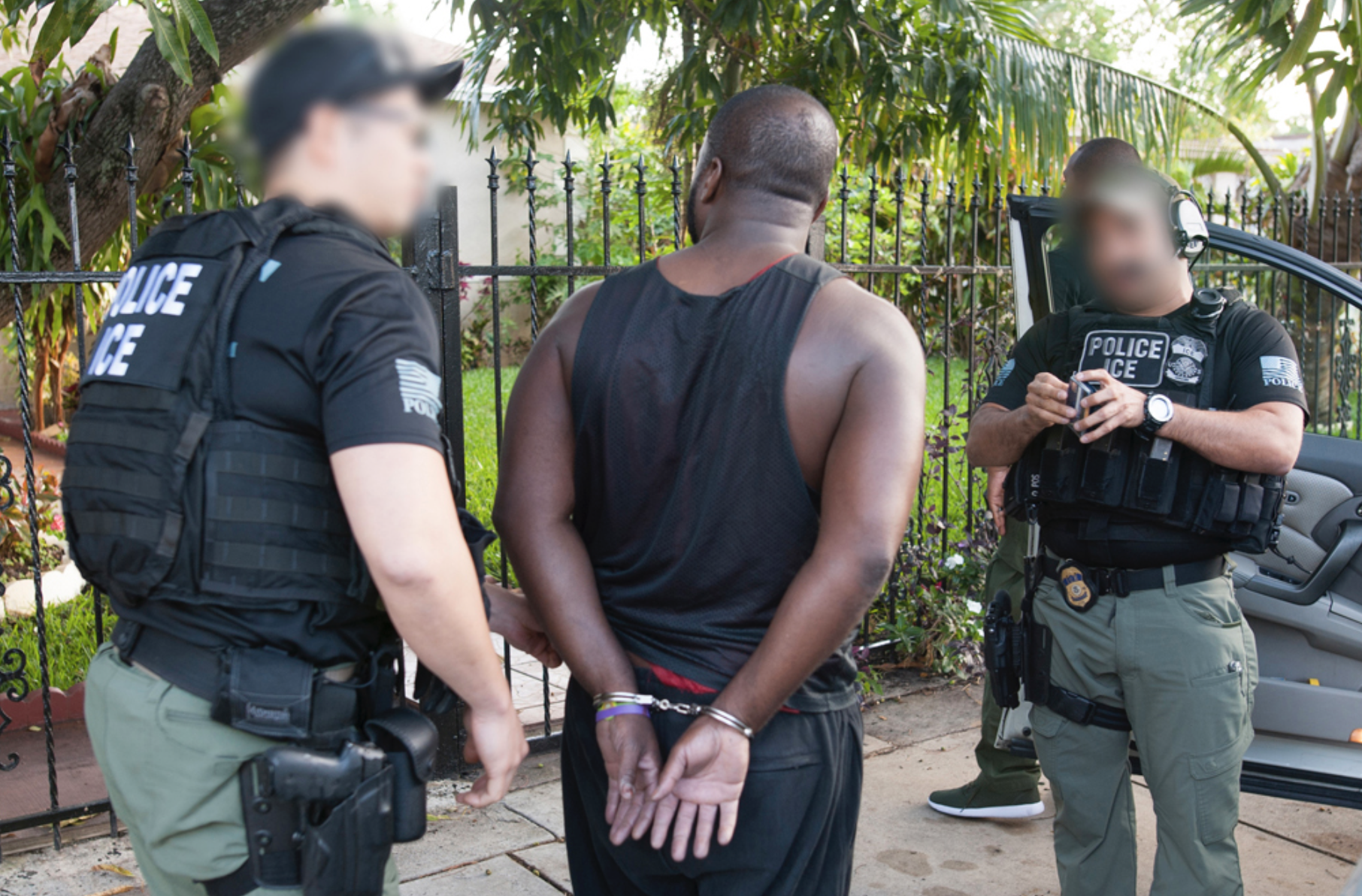
While it’s been extended under President Donald Trump‘s harsh immigration policy, the 287(g) program gets its name from Section 287(g) of the Illegal Immigration Reform and Immigrant Responsibility Act of 1996, a federal law signed by President Bill Clinton.
The provision allows U.S. Immigration and Customs Enforcement (ICE) to enter into agreements with state and local law enforcement agencies, deputizing certain officers to perform limited federal immigration enforcement functions. But wasn’t widely used until the early 2000s after 9/11. Some jurisdictions later abandoned the agreements during the Obama years after complaints about racial profiling and strained police-community relations. But it’s back.
Florida leads the nation in Section 287(g) immigration enforcement agreements, with state and local agencies holding over 300 active contracts. Miami’s agreement is known as a Task Force Model, one of the most expansive versions of 287(g). Under it, selected city police officers receive ICE training and authority to perform certain immigration enforcement functions in the field.
Supporters of the agreement argue that it:
- Helps identify and remove people who are in the country unlawfully and have committed crimes.
- Improves coordination between local law enforcement and federal immigration authorities.
- Enhances public safety by ensuring criminal offenders are not released before ICE can take custody of them.

- Helps local governments comply with state laws requiring cooperation with federal immigration enforcement.

Critics argue that it:
- Can make immigrants — including legal residents and mixed-status families — afraid to report crimes or cooperate with police investigations.
- Blurs the line between local policing and federal immigration enforcement.
- Can lead to racial or ethnic profiling if officers begin questioning people based on appearance, language, or accent.
- May undermine trust between police departments and immigrant communities, making neighborhoods less safe because witnesses and victims become reluctant to call law enforcement.
However, according to reporting and statements from city officials, Miami currently has only a small number of officers deputized under the agreement, and they have reportedly not yet conducted immigration enforcement actions under those powers. And while Miami’s “field office” has  reported the largest number of arrests, at more than 14,000, that includes all of Florida, Puerto Rico and the Virgin Islands. The Florida Suspected Unauthorized Alien Encounters Dashboard puts Miami in the top 20 jurisdiction when it comes to encounters through the 287(g) program, at 451. The Miami-Dade Sheriff’s Office has had fewer at 175.
But that doesn’t matter to those who say that the message is what’s important and that the message to all residents is harsh.
Read related: Eileen Higgins goes into Miami City Hall with a fire extinguisher and a smile
“One officer is too many,” said Tomás Kennedy, a well-known activist and policy advisor at Florida Immigrant Coalition.
“The message they are sending right now is that we are complying and collaborating in this broad witch-hunt against immigrants nationwide,” Kennedy told Political Cortadito. “It is regrettable, and sad, that this is happening in a city of immigrants.”
“Miami’s strength is its immigrant communities,” said Tessa Petit, executive director of the Florida Immigrant Coalition. “When local police become entangled in federal immigration enforcement, everyone is less safe. Residents deserve a city government that prioritizes public safety, trust, and inclusion, not policies that turn local officers into extensions of a federal deportation system.”
Advocates also say the city is not required by state law to enter into the agreement. Unlike sheriff’s departments or counties, Miami doesn’t operate any corrections facilities. So the law doesn’t technically apply to them, Kennedy said. The American Civil Liberties Union of Florida joined other advocates to send commissioners a letter this week informing them of this and will have a press conference outside City Hall Thursday morning  before the meeting.
“Entering into an agreement that deputizes local law enforcement to perform federal immigration enforcement is a choice—not a requirement,” said Amy Godshall, the ACLU’s immigrants’ rights staff attorney.“That choice comes at a cost. These agreements have been linked to unconstitutional racial profiling, where people are stopped, questioned, or targeted simply because of their accent or the color of their skin.
“Right now, the City of Miami has an opportunity to end this agreement before it continues violating people’s rights and becomes liable for the unlawful racial profiling carried out by its agents,” Godshall said.
Because if the optics don’t bother them, maybe the liability will.
During the campaign, Higgins didn’t mince words about her disdain for the contract. “There’s no reason in the City of Miami that our police department should be in the job of federal immigration enforcement,” she said at her first press conference after being elected.
Immigrant advocates heard her. They believed her. They voted for her.
And then… nada.
Seven months into her administration, the agreement remains in place. Activists have repeatedly demanded action. There have been text message 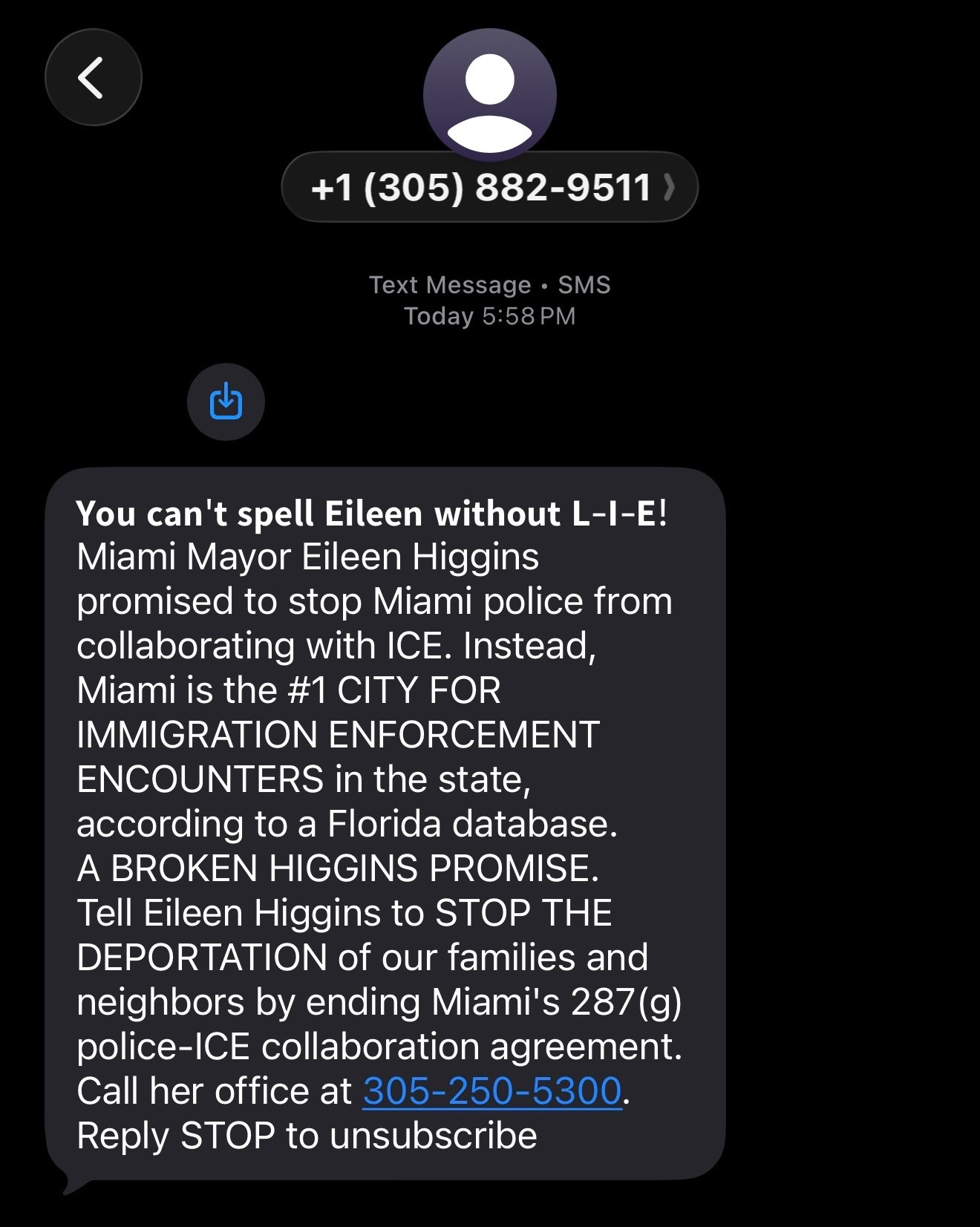 blasts accusing Higgins of breaking her promise and urging voters to call her office to complain.
“You can’t spell Eileen with L-I-E. Miami Mayor Eileen Higgins promise to stop Miami police from collaborating with ICE,” one of them reads. “A broken Higgins promise. Tell Eileen Hggins to stop the deportation of our families and neighbors by ending Miami’s 287(g) police-ICE collaboration agreement.”
Immigration and climate advocate Laura Muñoz was even pushed away by the mayor’s staff while trying to ask Higgins about the issue during a public event. The badly-handled moment as Muñoz was told that was not the time was captured on video and posted on social media.
Several public speakers have also said at previous commission meetings that they expected the mayor to do something when she was elected. But Higgins seems uninterested in anything except her $450 bond initiative.
At last week’s swearing in for the new police chief, former Doral Chief Edwin López, Higgins said that under his watch, “every person in this city — regardless of immigration status — will be treated with dignity, respect and humanity.”
For his part, Lopez told the Miami Herald that his “zero tolerance” approach was about violence toward children, murderers and burglars — not the undocumented in the community. “My priority is not to enforce anything related to immigration,” he is quoted as saying.
Read related: Miami Mayor Eileen Higgins gets rebuffed — for now — on $450 mil bond
Despite campaigning on it, Mayor Higgins — who does have the ability to bring it to the commission, like she brought the bond — has said that it is up to the commission to undo the 3-2 vote last year.
Which brings us to Thursday.
The discussion item was placed on the agenda by Commission Chairwoman Christine King, who has shown little urgency on the matter until now. And what remarkable coincidence accompanies King’s sudden interest?
Higgins won’t be there. The mayor is proudly — and conveniently — representing Miami on her first taxpayer-paid trip as mayor, attending the London Climate Action Week event.
Maybe it’s purely timing. Or maybe it’s politics. After all, City Hall has been buzzing for weeks about tensions between King and Higgins. There 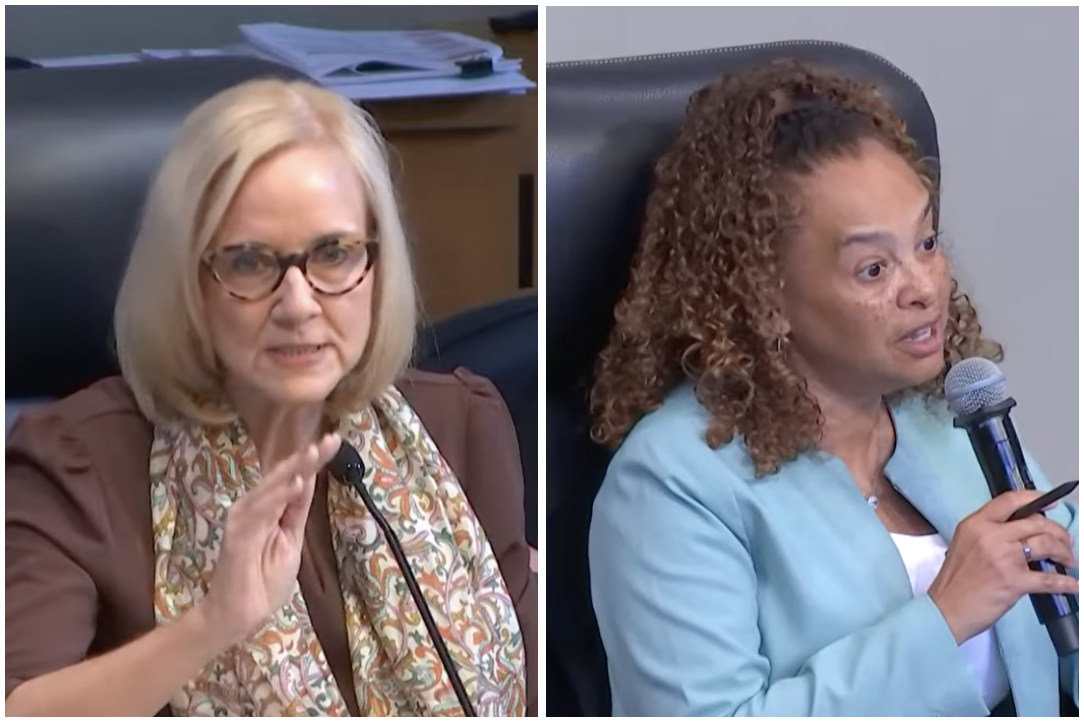 have been whispers that Higgins considered replacing King as chair. That hasn’t happened. Yet.
But getting the cold shoulder from the mayor, immigrant advocates went to King and asked her to put it on the agenda.
So, now commissioners will get to publicly discuss one of the mayor’s most uncomfortable political liabilities while the mayor is several thousand miles away and five time zones removed from the conversation.
Remember, Ladra doesn’t believe in coincidences.
Again, Thursday’s item is only a discussion. Maybe King — who along with Commissioner Damian Pardo voted against the agreement last year — doesn’t think she has the votes, but someone could make a motion Thursday and end the agreement right there and then. The one question mark is Commissioner Rolando Escalona — replacing Joe Carollo, who voted in favor last year after a long speech about his own immigration journey — who could vote to rescind the agreement. Sources say Escalona doesn’t like it much.
And Commissioner Miguel Gabela — who switches positions in real time at almost every meeting — may also decide he made a mistake voting for the agreement last year after so many people have spoken against it. In fact, it’s possible that not one public speaker has been in favor of the 287(g) agreement.
But, no matter what, the meeting will offer something Higgins has largely avoided since taking office: a public conversation about a promise many voters thought she intended to keep.
The real questions are (1) whether anyone will explain why it’s still there, (2) if Police Chief Manny Morales — who is reportedly running for commissioner in District 4 — will defend it, and (3) whether the mayor plans to do anything about it when she gets back from jolly ol’ England.
The Miami City Commission meeting starts at 9:30 a.m. at City Hall, 3500 Pan American Drive, and can be seen live on the city’s website and also on the city’s YouTube page.
This kind of independent, government watchdog reporting is crucial to transparency and democracy. And more so every day. Help shine a light on the darker corners of our community with a contribution to Political Cortadito. Click here. Ladra thanks you for your support.

Miami commission to discuss 287(g) ICE agreements–sans Mayor Eileen Higgins added by Ladra on
View all posts by Ladra →