
Why change 100 years of elections? Who really benefits?
Opinion By Melissa Castro, Coral Gables Commissioner
For nearly a century, Coral Gables has held its elections in April. That was not random. It was intentional. It ensured that local elections stayed focused on local issues like development, traffic, infrastructure, and the character of our neighborhoods.
Now, right as concerns about overdevelopment reach a peak, there is a push to change that system. That is not timing. That is strategy.
A recent survey conducted the week of February 18, with a sample size of almost 400 respondents of Coral Gables voters makes the stakes clear. Overdevelopment ranked as the number one concern, with 47% of residents naming it their top issue and 74% placing it among their top three priorities. Corruption followed closely, with 54% ranking it among their top concerns.
Read related: Coral Gables voters to decide their city’s future — from their mailboxes at home
Residents are not asking for faster growth. They are asking for control. And yet, at the same moment those concerns are rising, the rules that determine who makes those decisions are being rewritten.
Recent reporting from the Gables Gazette (ANALYSIS: New density, old strains – Concurrency and the future of North Gables) 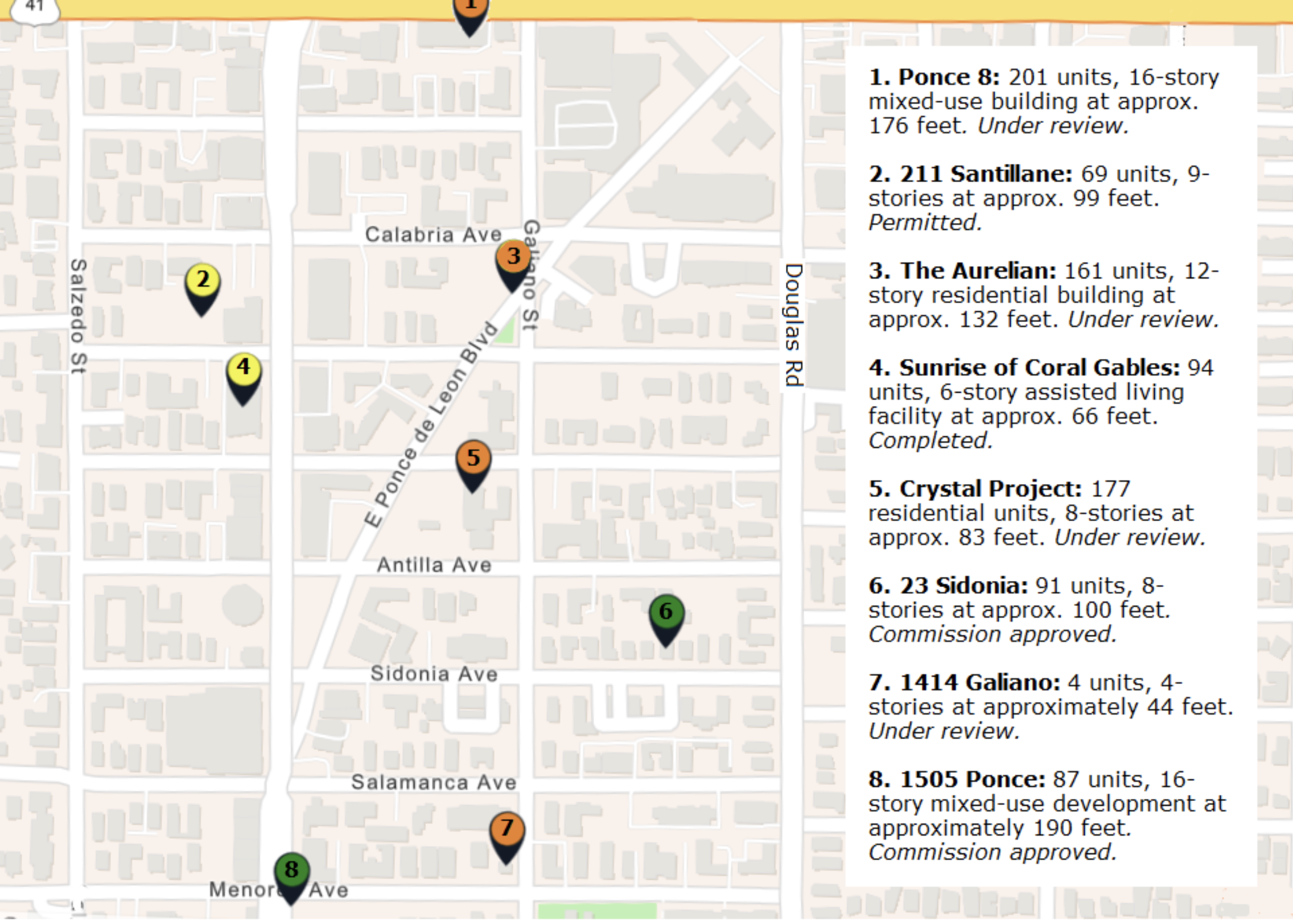 highlights more than 900 residential units proposed within just a few blocks in North Gables, raising serious concerns about traffic, infrastructure, and neighborhood character.
What changing election timing actually does: It changes who shows up. It changes who has influence. And it changes who wins.
April elections are local by design. The voters who participate are engaged in city issues. November elections are not. They are dominated by national races, higher spending, and outside influence. Political science research from the University of Chicago Center for Effective Government shows that when local elections are moved to coincide with national cycles, campaigns become more expensive and more influenced by well funded, organized interests.
And in local government, one of the most organized and well funded interests is the development industry. Research from Harvard Kennedy School has shown a direct relationship between real estate contributions and increased development approvals.
So let’s stop pretending this is neutral.
When more money enters local elections, influence shifts. When influence shifts, development decisions follow. And when that happens, overdevelopment accelerates.
Read related: Coral Gables voters to get sweeping charter changes ballot only by mail
There is another reality that cannot be ignored. Coral Gables has a large base of long-time, consistent voters who have  participated in April elections for decades. These are residents who follow local issues closely and show up specifically for them. Moving elections to November does not “expand” their voice. It dilutes it.
Because November ballots are crowded. Local races get buried. Researchers at Citizens Union call this ballot roll-off, where voters participate in high-profile races but skip the local contests that directly impact their neighborhoods.
So what happens? Local voters participate less. Outside influence participates more.
That is not more democracy. That is a shift in power.
And we have not even addressed the most important point: This is not just a policy change. These referendum questions amend the City Charter, the governing document of Coral Gables. In many ways, it functions like a local constitution. Changing it is not temporary. It rewrites ho w power operates in this city, and once those rules are changed, they are not easily undone.
So again, the question is not complicated.
Who benefits?
Because it is not the residents who are already raising concerns about overdevelopment, traffic, and transparency. It is the interests that benefit from more influence, more access, and faster approvals. This is not about convenience.
It is about control. Control over elections. Control over development. Control over the future of Coral Gables. According to the Florida Bar Journal, local governments control zoning, land use approvals, and development processes. These are the decisions that determine how quickly growth moves forward and how it affects neighborhoods.
So before supporting this change, ask yourself one simple question: Why change 100 years of elections if the result is giving up local control? Because once this shift happens, it will not be easy to reverse. And the consequences will not be theoretical. They will be built into our neighborhoods.
Coral Gables Commissioner Melissa Castro was elected in 2023 by 59% of the voters and was appointed last year by the Florida League of Cities to serve as Vice Chair on the Florida League of Cities 2025-26 Development, Code Compliance and Redevelopment Committee, one of the League’s five Legislative Policy Committees. This opinion piece reflects research, her personal views only and does not represent the official position of the City of Coral Gables. No city resources were used in the preparation of this article, which is not paid or sponsored content.

Op-Ed: Gables Commissioner Melissa Castro on pro-development referendum added by Ladra on
View all posts by Ladra →
