
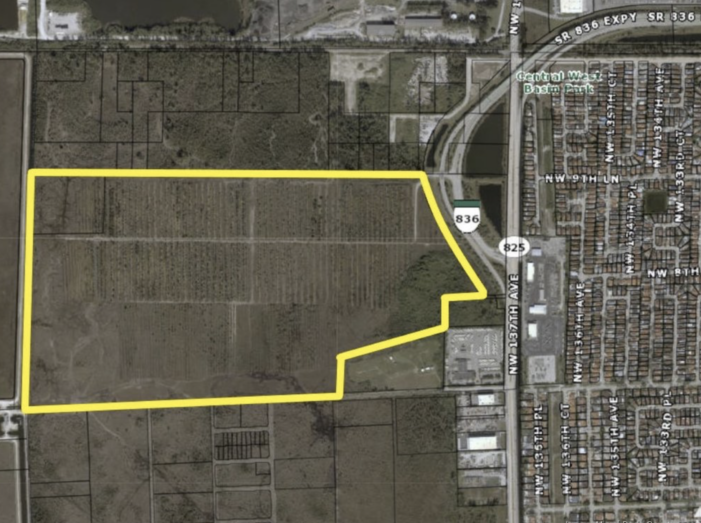
And this could be a test case for the UDB expansion
Namaste.
The veto that promised to launch a showdown quietly dissolved Wednesday into what can aptly be described as parliamentary yoga.
Miami-Dade Mayor Daniella Levine Cava’s dramatic Feb. 1 veto of the Kelly Tractor wetlands project didn’t get overridden. It didn’t get sustained either.
It got, well, sidestepped.
Instead of forcing a vote to override the mayor and test whether she truly had the nine commissioners needed to block the project,  the commission opted for a procedural reset. In plain English: they voted to reconsider their Jan. 22 approval at a later date.
So, now, everybody lives to fight another day.
The move keeps the 246-acre Kelly Tractor headquarters proposal alive — very alive — but sends it back to the workshop for what supporters are calling “environmental safeguards” and what critics are calling “let’s try this again with better optics.”
Read related: Daniella Levine Cava vetoes approval of Kelly Tractor complex across UDB
“The Urban Development Boundary exists for a reason,” Levine Cava told commissioners Wednesday morning. “Growth must be responsible. It cannot be unbridled.”
Strong words. But instead of a public arm-wrestling match over her veto, Commissioner Juan Carlos “JC” Bermudez — whose district includes the tree farm-turned-battleground near where State Road 836 runs out of asphalt — proposed the do-over. He said he wanted to give Kelly Tractor and county staff a month to work something out. “The applicant is okay with it.”
But he sounds like he is solidly behind the project — and also the expansion of the UDB.
“ It’s going to be back in front of us … and at that point, we’re going to have to make a decision. And the mayor may take the same  position, and if the mayor does take the same position, then I think we all know what we have to do,” Bermudez warned “At least I know what I’m gonna do.
“I think I know what I would do today and what I will do a month from now.”
That’s not subtle.
Then he pivoted to the UDB, which is being crossed already by several other projects in the pipeline. ”It was never meant to be a permanent line,” he said. “Never, ever, ever. That’s why Broward doesn’t have one. That’s why Palm Beach doesn’t have one.”
Read related: Miami-Dade considers an industrial hub on 245 acres of protected wetlands
The January vote was 9-2 in favor of the project. Overriding a veto would have required nine votes if all 13 commissioners were present. One of those original yes votes, Commissioner Raquel Regalado, had already flipped to the mayor’s side this week, complicating the math.
Rather than risk an embarrassing miscount — for either side — the board chose delay.
Kelly Tractor now says it will rework the proposal to address Levine Cava’s concerns. That could mean preserving more wetlands on-site or offering additional mitigation elsewhere. Company president Chris Kelly says they’re “going to work on the wetlands issue.”
What hasn’t changed is the scale. The plan still envisions more than 2.2 million square feet of buildings, rail access, repair bays, fueling depots, truck washes, and even a helicopter pad — largely on protected wetlands outside the UDB, which was established in the 1970s basically to stop this very project from happening. It is supposed to curb urban sprawl, protect the Everglades and wetlands from development encroachment and protect our critical water resources, which are especially sensitive now during this drought. It is a “growth boundary” line that separates urban and suburban areas from agricultural land, because expanding indefinitely westward increases flood risks and infrastructure costs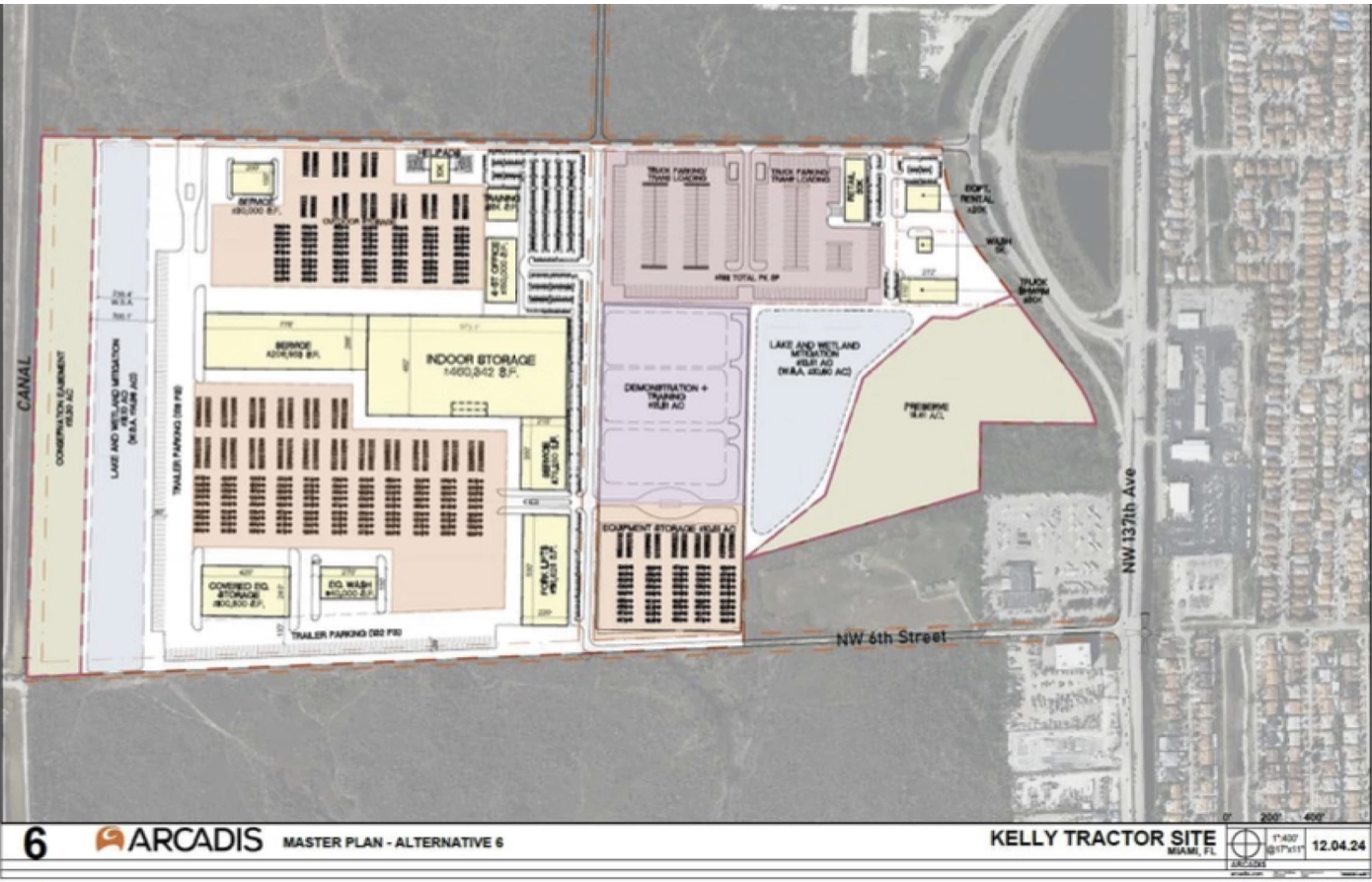
Pro-growth commissioners, like Bermudez, argue it’s outdated. Environmentalists argue it’s the last thin green line between sprawl and catastrophe.
And that’s where this gets bigger than Kelly.
Bermudez made it clear Wednesday that the real fight isn’t just about one equipment dealer. This will come up again. And he thinks the line should move. “It was created to be revisited. And we are doing it application by application,” he said.
Read related: Florida, Miami-Dade mayor warn about water shortage, possible restrictions
But Kelly’s application became the flashpoint in part because it bypassed the traditional zoning process. Instead of filing a full zoning application with detailed site plans and demonstrated need, the company used a text amendment to the county’s Comprehensive Development Master Plan — typically a tool for refining policy, not approving mega-projects.
Levine Cava has zeroed in on that.
“When you have a full application, you can see exactly what’s going to happen and discuss those exact impacts,” she said. “They have not been able to establish why it was necessary for them to go outside the UDB to build this.”
Commissioner Oliver Gilbert wasn’t convinced negotiations will fix the core issue either.
“Your point fundamentally is that you don’t want the functional expansion of the UDB via the text amendment process,” he said. 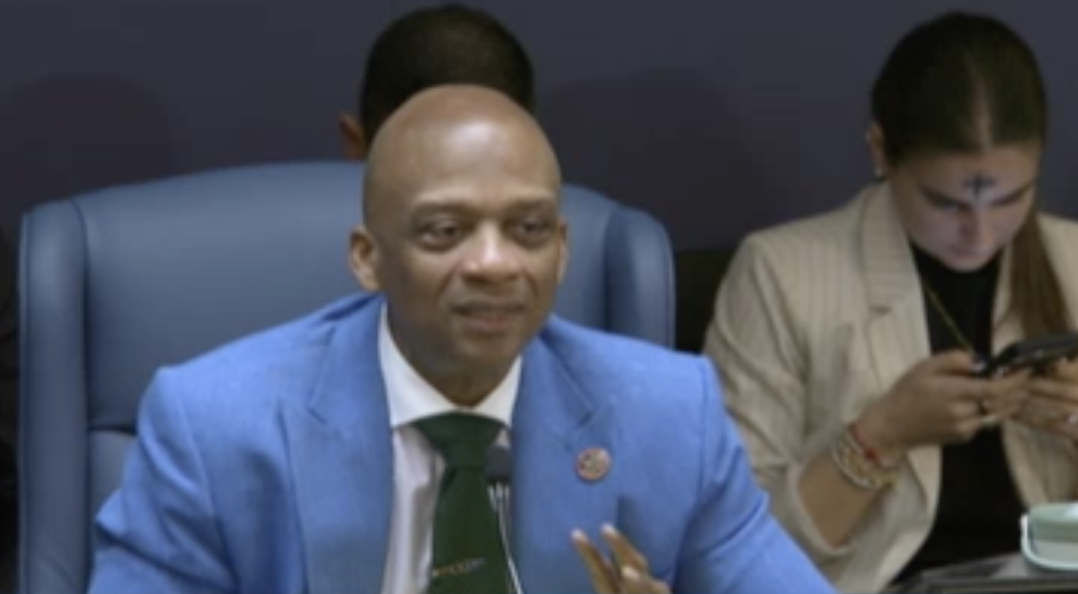 “That point cannot be remedied with negotiations.”
So here we are.
The veto is technically still there — but it’s moot for now. The showdown has been postponed until March, when the application is expected to return, presumably dressed up with more wetlands preservation and maybe a prettier bow.
What Wednesday really did was buy time.
Time for Kelly Tractor to tweak. Time for commissioners to recalibrate. Time for the mayor to keep assembling votes. Time for the larger UDB war to heat up.
This spared commissioners from having to publicly defy the mayor — or publicly back down from her — in a clean override vote.
It also spared Levine Cava from finding out, definitively, whether she actually had the nine.
Instead of a decisive victory or defeat, Miami-Dade got a timeout.
The bulldozers are still in the parking lot.
And the Urban Development Boundary just became a campaign issue.
If you like what you read on Political Cortadito, please consider making a contribution to support the independent, government watchdog journalism on this website. Thank you!

Kelly Tractor showdown delayed as Miami-Dade commission sidesteps veto added by Ladra on
View all posts by Ladra →
[…] Read related: Kelly Tractor showdown delayed as Miami-Dade commission sidesteps veto […]
[…] Read related: Kelly Tractor showdown delayed as Miami-Dade commission sidesteps veto […]
I noticed Commissioner Juan Carlos “JC” Bermudez is up there , Doral residents thought he was owned by developers when he was Doral Mayor yet the current Mayor Fraga is WORSE but ” smarter ” as far as fooling the easily conned as she makes it look like the development she enables in some way benefits us .
She is the ultimate Cubana Cosa Nostra .
I work nights till AM but last 3 weeks it has been late afternoon till night and what a monster of traffic in Doral even with all the deportation’s ( was needed ) .
This is a common tactic when the people speak, the applicants council feels like they might not have enough votes so they defer it to another day. The part many don’t realize, is when they come back to the BCC, applicant attorneys, will present some small fixes, but unfortunately, the people never get to speak because the opportunity was used up at the prior meeting.. so basically the people have no rebuttal. And it gives the impression that the commissioners paid attention to the people had the applicant go back to the drawing board but in the end, it’s just a Schell game and the general public better known as the constituents never get a fair chance.
”Levine Cava cannot tell commissioners what to do, how to conduct their meetings, or when to take a vote on something.”
True and IMO a sweet older lady surrounded by Cuban political serpents who would throw their own mothers under a bus for developers money
Lets get a charter amendment, ask the voters, should the UDB be a permanent boundary. It should, at some point is needs to STOP.
Broward does not have a UDB and it is now built out. There’s no room for anything, and it actually does have a natural UDB, namely the big pile of wetlands we pass through whenever taking I-75 west. You can’t build there.
Dade is not Broward. It is not Palm Beach. It is Dade, and it has a huge national park to its west which can’t be built on. That park, it is now obvious (thank you, MSD), is really, really important to the health of our environment. We are approaching drought conditions due to a lack of rain this dry season. Are people really stupid enough to believe that it is okay to keep building west?
We have a lot of blight in Dade County that could use a little refurbishment. Instead of giving up pristine public land for private interests, or re-zoning sections of our very necessary environmental buffer, perhaps Dade County and its municipalities should create an environment conducive to redevelopment in blighted areas. Then additional investments in public transit and other infrastructure (grocery stores, entertainment and the like) are justified and justifiable.
Improve and repair what we’ve already ruined. Don’t further carve up Eden.
They must not have had enough support to override, and so they’re waiting it out to see if opposition to the proposal dies down in the meantime. Levine Cava cannot tell commissioners what to do, how to conduct their meetings, or when to take a vote on something.
This action by Miami-Dade County elected officials shows how corrupt they are. It is much too easy to bribe elected officials to harm nature and steal land from taxpayers. Why didn’t Cava demand a vote? Why does Cava let corrupt commissioners bend to the will of campaign contributors AKA developers?