
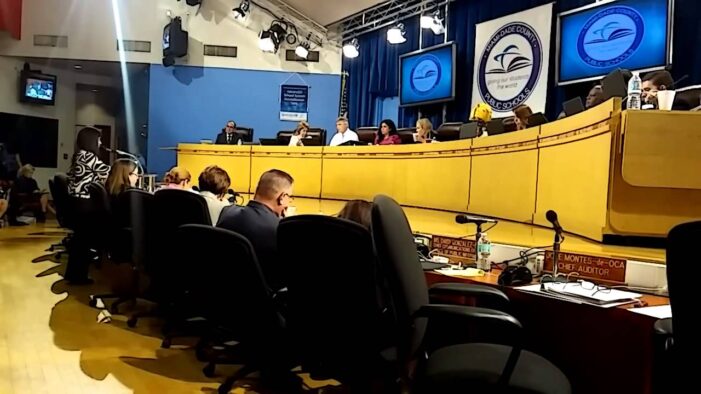
Qualifying deadline is two weeks away
With barely two weeks left before qualifying closes, not a single sitting Miami-Dade County Public Schools board member up for re-election has drawn a challenger.
Which is either a stunning vote of confidence in the current board — or a giant blinking sign that nobody wants this job anymore.
Probably a little of both.
Because while the rest of Miami-Dade politics resembles a demolition derby fueled by PAC money, vendettas and group texts that should probably be subpoenaed, the school board races are sitting there untouched like the last pastelito at a vegan brunch.
No challengers. No insurgents. No angry parents mounting campaigns. Not even the usual random guy with a Facebook page.
School Board Members Dorothy Bendross-Mindingall, Mari Tere Rojas, Monica Colucci and Roberto Alonso could just slide back into 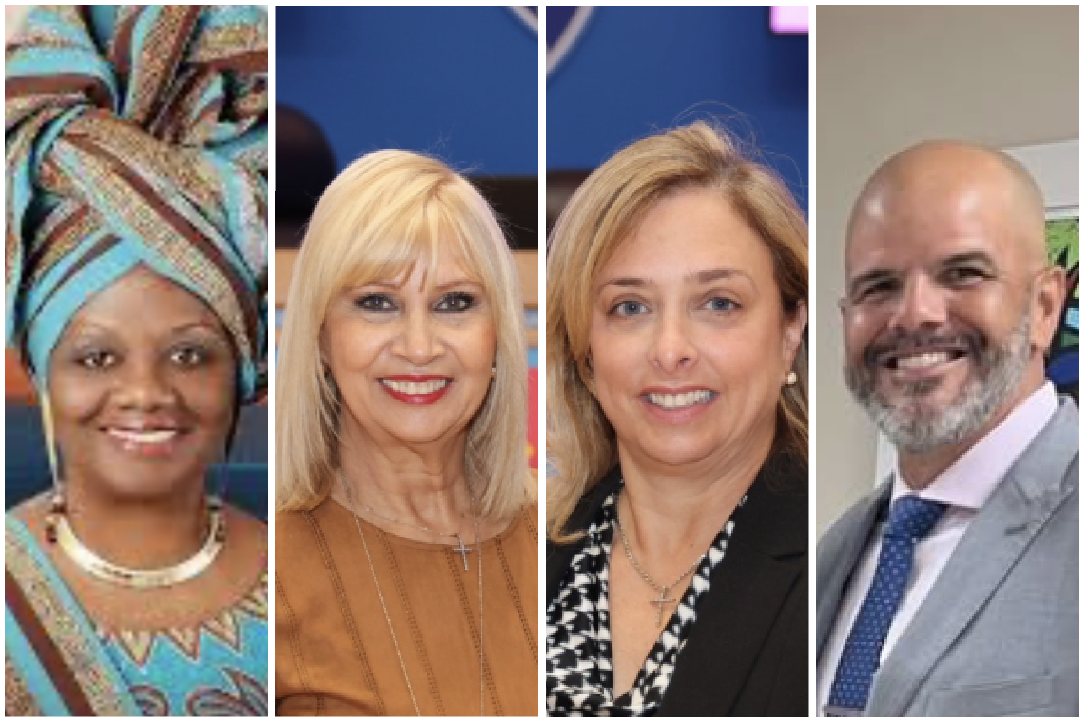 their seats without having to defend a vote they’ve taken or say what their priorities will be.
And this is happening while the board is preparing to make one of the biggest decisions in public education locally in years: choosing the next superintendent for the nation’s third-largest school district.
Assuming, of course, we’re all still pretending that decision hasn’t already been made somewhere quietly over cafecito in Tallahassee.
Read related: Miami-Dade School Board rejects outside help for superintendent search
The irony here is almost too Miami to process.
Education in Florida has never been more politically radioactive. Charter schools, vouchers, book bans, curriculum fights, “parental rights,” declining enrollment, school consolidations, budget cuts — school boards have effectively become the front lines of Florida’s culture wars.
And yet in Miami-Dade County? Silence.
Maybe people are exhausted.
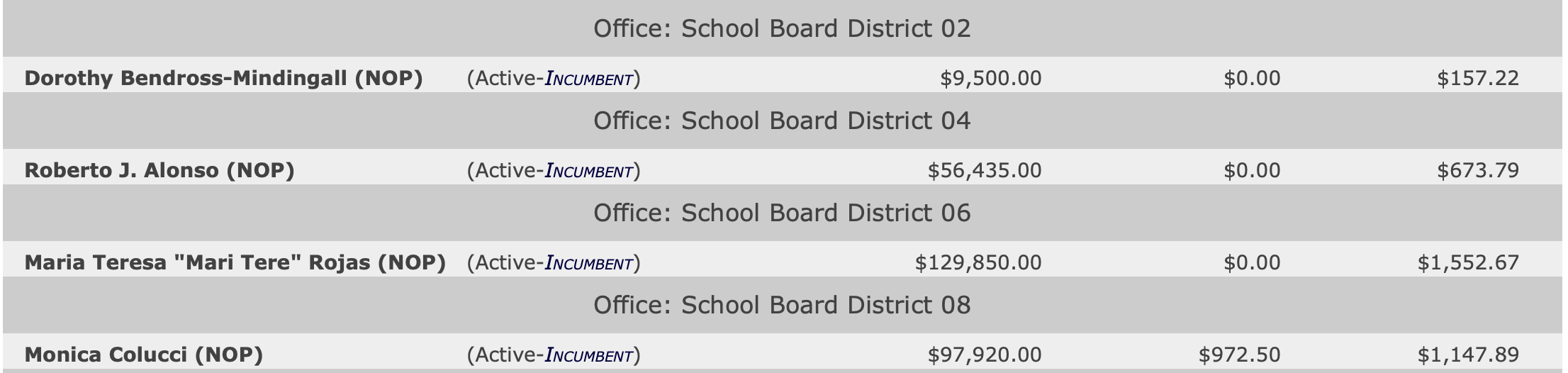
Maybe they’re looking at people like Bendross-Mindingall, the longest-serving member who was first elected in 2010 to replace outgoing chair Solomon Stinson, and are skittish. She’s a veteran teacher and principal and has deep institutional knowledge, strong community ties and a solid voter bloc that has kept her in office since, winning her last race with 75% of the vote against La-Shanda West.
They’re looking at Rojas and see the sister of a sitting congressman with an enormous and generous donor list. She already has almost $130,000 in her campaign account and about $90,000 in her political action committee, It’s All About the Kids. “Maria Rojas,” as she is technically known on Ballotpedia, first won in 2016 with 66% against Modesto Abety, who was involved in The Children’s Trust. Rojas was unopposed in 2018 and beat Sandra Manzieri in 2022 with 64% of the vote.
And when they look at Alonso and Colucci — handpicked to run by Gov. Ron DeSantis to run against Republicans who didn’t toe the line on face masks and other COVID19 extremism — see the guv and former Lt. Gov. Jeannette Nuñez doing TV commercials for them getting the local Republican Party putting boots on th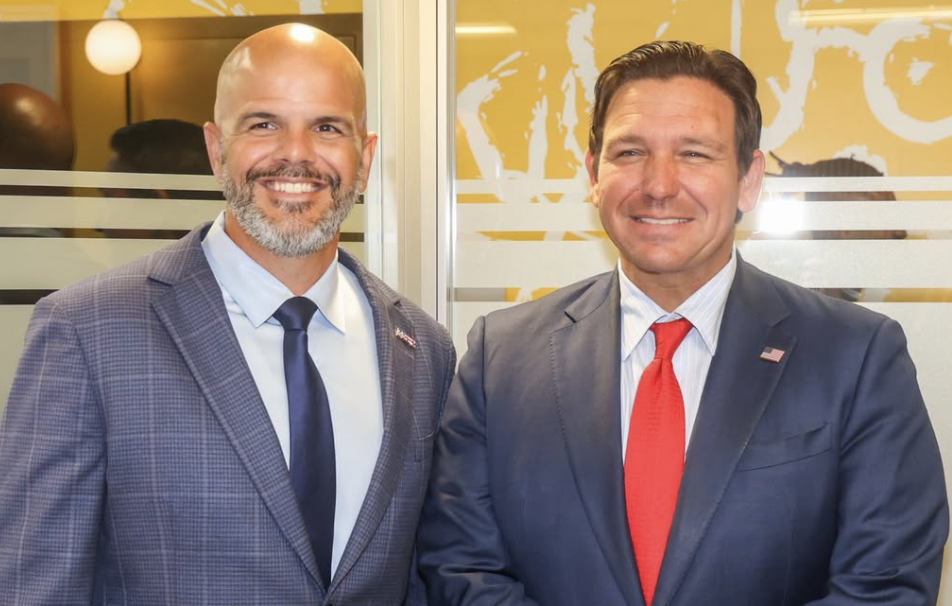 e ground. Alonso basically forced longtime chairwoman Perla Tabares Hantman to resign. And Colucci beat veteran School Board Member Marta Perez with 54% of the vote in 2022, a small margin probably due to the GOP support.
Maybe potential candidates look at the current climate and decide they’d rather fight an alligator barehanded than spend four years getting screamed at over library books and LGBTQ month by people livestreaming from the back row.
Or maybe everybody understands what these races have become.
Because Miami-Dade school board elections stopped being sleepy little neighborhood contests years ago. Gov. DeSantis nationalized them. Suddenly, nominally nonpartisan education races became ideological warfare with endorsements, PACs and Tallahassee fingerprints all over the ballot.
Read related: Miami-Dade School Board gets extreme makeover with two hard right newbies
Candidates are lazy, too. Let’s be honest about that part.
There are now term limits on the school board, and all four incumbents up this cycle would be serving their final terms anyway. Which means ambitious political types are likely looking four years down the road and thinking: “Why waste money and energy fighting an incumbent now when I can wait for an open seat later?”
Open seats are easier. Cleaner. Less expensive. Less risky. There’s no incumbent advantage. No established donor machine.
So instead of challenging sitting board members now, a lot of potential candidates are probably sitting around marinating quietly in ambition, waiting for the musical chairs game to start in 2030.
Still, even by Miami standards, this is weird. It’s rare to see school board incumbents challenged. But it’s even rarer to see not a single one challenged.
Especially now.
Because the board is not exactly navigating calm waters. The upcoming superintendent search alone should be enough to trigger political interest. 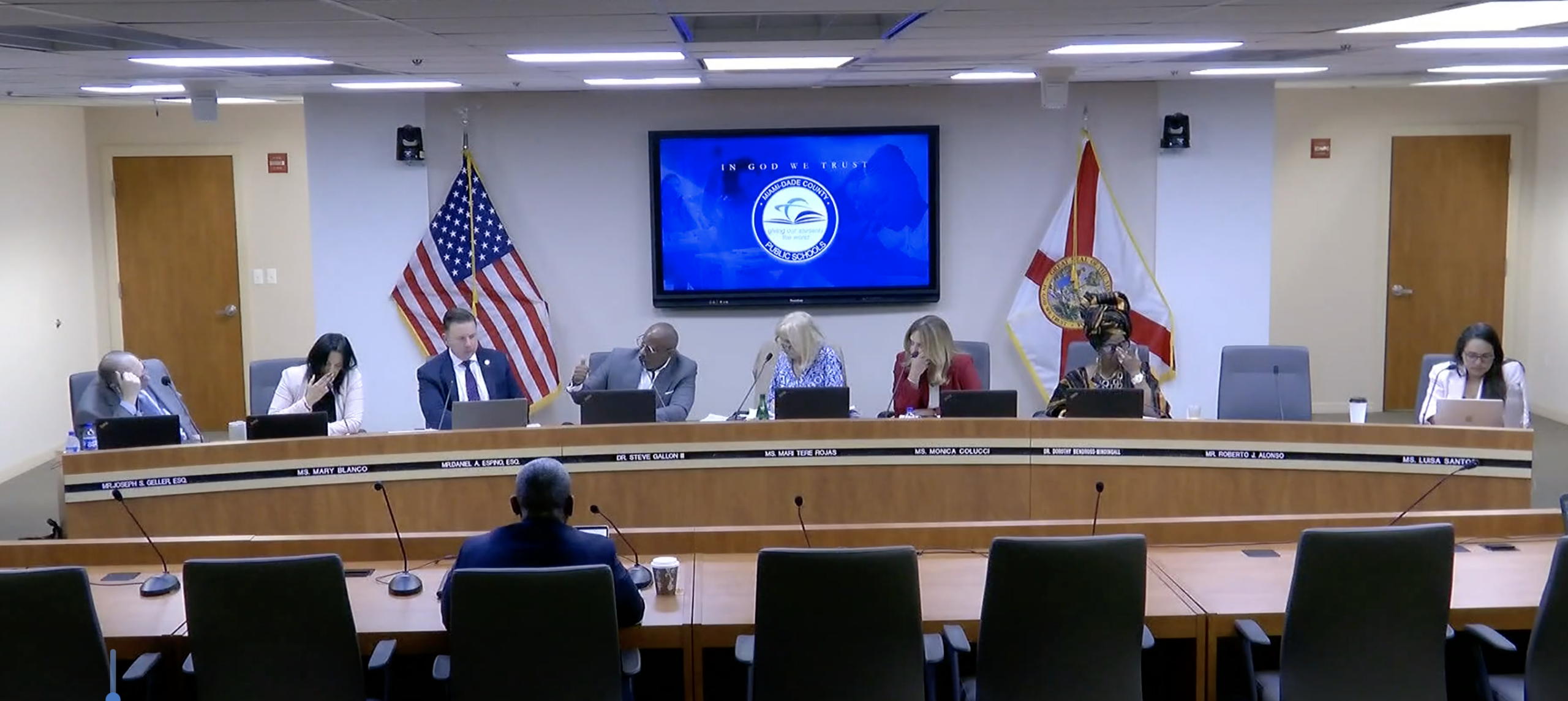 The last superintendent selection process in 2022 was widely ridiculed as rushed, predetermined and embarrassing — what even some board members openly called a sham.
This time, officials promise transparency. Community engagement. Public participation. A broader search.
Sure. And Ladra is finally going to start yoga next week.
The Miami Herald editorial board practically begged school board members not to repeat the same seven-day sprint fiasco that elevated Jose Dotres to the top job after a process many critics said failed “the smell test.”
Already floating publicly is the name of Republican State Rep. Alex Rizo, who conveniently said he would “listen” if approached about the position.
Which in Florida political dialect loosely translates to: “Somebody already floated the idea to me.”
Read related: LGBTQ History Month debate back at Miami-Dade School Board with vitriol
Meanwhile, public schools face real issues: declining enrollment, budget pressures, teacher burnout, school closures, charter expansion, voucher competition, and the ongoing slow siphoning away of students and resources from traditional public education.
Yet nobody appears eager to fight for a seat at the table.
That says something.
Maybe voters are satisfied. Maybe challengers are still coming at the last minute. Or maybe everybody already believes the real decisions are being made elsewhere anyway.
And frankly, that last possibility may be the most dangerous one of all.
Because when people stop running for school board seats in one of the largest districts in America during one of the most politically consequential eras in public education history, it doesn’t exactly scream civic confidence.
It screams exhaustion.
Nobody is really covering the school board. Not like this. This kind of independent, government watchdog reporting is crucial to transparency and democracy. And more so every day. Help shine a light on the darker corners of our community with a contribution to Political Cortadito. Click here. Ladra thanks you for your support.

Nobody wants the job: Miami-Dade School Board races could be dismissed added by Ladra on
View all posts by Ladra →
