

Photos were posted on social media over the weekend of several ambulances taking people to the hospital from Alligator Alcatraz, that makeshift prison built in eight days with no oversight and even less compassion on an abandoned air strip in a flood prone area in the middle of the Everglades just last month.
One was spotted leaving at 3:37 p.m. Saturday and another one at 8:30 p.m. Two were seen leaving on Friday, at 10:30 a.m. and 6:30 p.m. And two others at 6:10 p.m. and just before midnight on Thursday.
Some detainees are in their 11th day of a hunger strike to denounce the conditions, so that may explain some of the hospitalizations.
Read related: Daniella Levine Cava finally takes a tougher stand vs Alligator Alcatraz
But at least six people had been reportedly transferred from the facility before the hunger strike began. That means at least 12  people — it’s probably more — either sick or injured, have been rushed to the hospital more than 40 miles away from the gulag in the middle of the swamp, built atop the old Dade-Collier Training and Transition Airport.
And the Miami-Dade Department of Health is… ¿Dónde está? Playing hide and seek? Practicing yoga? Trying not to make eye contact?
Because someone should be asking very loudly:
- Who is monitoring the health and safety standards at Alligator Alcatraz?
- Is there even a doctor on site? A nurse? A thermometer?
- Where are the medical records for these transfers?
- Has anyone at DOH even stepped foot inside this place?
Let’s not forget: this facility was thrown together like a last-minute science fair project — only the prize was millions in taxpayer dollars wasted and the experiment is on actual people. The budget is $450 million — $290 mil of which has already gone to vendors with no open competitive system, no transparency (more on that later) — so what have they spent on healthcare?
According to a bunch of contacts published by the Miami Herald, CDR Healthcare Inc. was hired to build, staff and maintain a medical unit where they would administer drug tests and TB tests, for $17.5 million. Where is that money really being spent?
UPDATE: A spokesman for CDR Healthcare told Political Cortadito Monday that they have no record of a detainee who did not get his inhaler.
“Any patients being transported are being done so to protect their medical health and ensure they get proper access to care if medical staff onsite deem they have medical conditions that require further and advanced treatment NOT because of conditions onsite,” wrote a political strategist PR guy in Tallahassee.
“All patients receive a full health assessment upon intake and receive fololw up care based on the results of that assessment including daily medications,” he said. “A doctor is onsite 24/7 along with a full staffing of medical personnel who work hand in hand with DOH.”
But if everything is so copacetic, why aren’t they providing this information to families and attorneys and immigrant advocates who have repeatedly denounced the “dangerous and unlawful conditions” inside the state-managed immigration detention camp which they medical experts say could lead to some serious health risks for the hundreds of detainees who are being held there in group cages. Phone calls with detainees and their families have brought horror stories to light.
Toilets that don’t flush. Limited drinking water. Meals with bugs or maggots. Giant mosquitos that could be carrying illnesses. Access to showers once a week. Temperatures that drop to freezing cold from sweltering hot and back again, regularly.
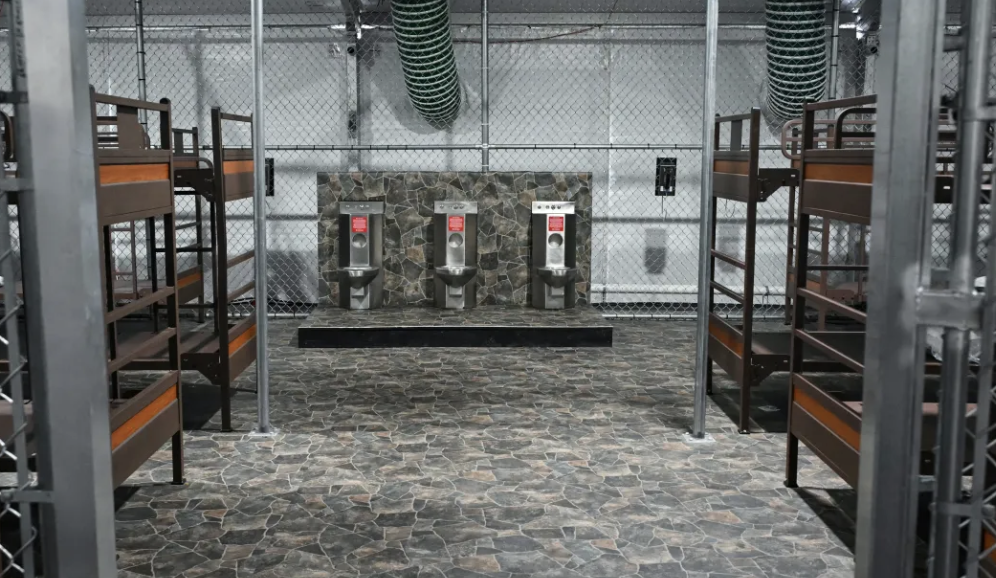
“People detained at Alligator Alcatraz have had to remove fecal matter from the toilets with their bare hands because the toilets lose pressure due to lack of water,” said Thomas Kennedy, Policy Consultant at the Florida Immigration Coalition and a longtime activist who added that those are the “depraved conditions” that drove some to a hunger strike.
“We see hospitalizations every day,” said Kennedy, who is regularly in touch with the family members of more than a dozen detainees, including the mother of one — a Dama de Blanco activist who fled persecution in Cuba — whose son had stage four hemorrhoid surgery last month and was reportedly sent back to Alligator Alcatraz, but there is no record of him. Like he disappeared. Another detainee is asthmatic and spent two weeks without his inhaler, Kennedy said.
While the detainees held at this remote concentration camp do not show up on the Immigration and Customs Enforcement online locator system, the last visitors to the facility, Mexican consular officials, said there were about 1,200 detainees, although there have been some recently moved to the Krome Detention Center, Kennedy said. One reason is because they are way past the 14-day limit they can be held there and the other is to break u the hunger strikers, he said.
“This isn’t a detention facility — it’s a public health experiment gone horribly wrong,” said Sebastian Caicedo, Miami-Dade regional director at Florida Rising, at a protest last month. “People are being exposed to viruses, sewage, and extreme trauma. It’s state-sponsored cruelty, and it has to stop.”
“The internment camp is an atrocity in our community,” said Tessa Petit, the co-executive director, of the Florida Immigration Coalition, one of the groups leading the opposition to Alligator Alcatraz. “The conditions under which people are detained raise major medical concerns,” she said.
Read related: Miami-Dade could go above and beyond to help ICE with local detainees
And, while the ICE Barbie Kristi Noem continues to say that Alligator Alcatraz is housing the worst of the worst, the vilest criminal element, the Miami Herald published a list of detainees that show a third of the known prisoners there have no criminal conviction or charge against them in the U.S. They are simply there because they violated immigration law, like overstaying a tourist visa.
Some reportedly have asylum cases, according to Herald reporter Ana Ceballos, who has been reporting on Alligator Alcatraz 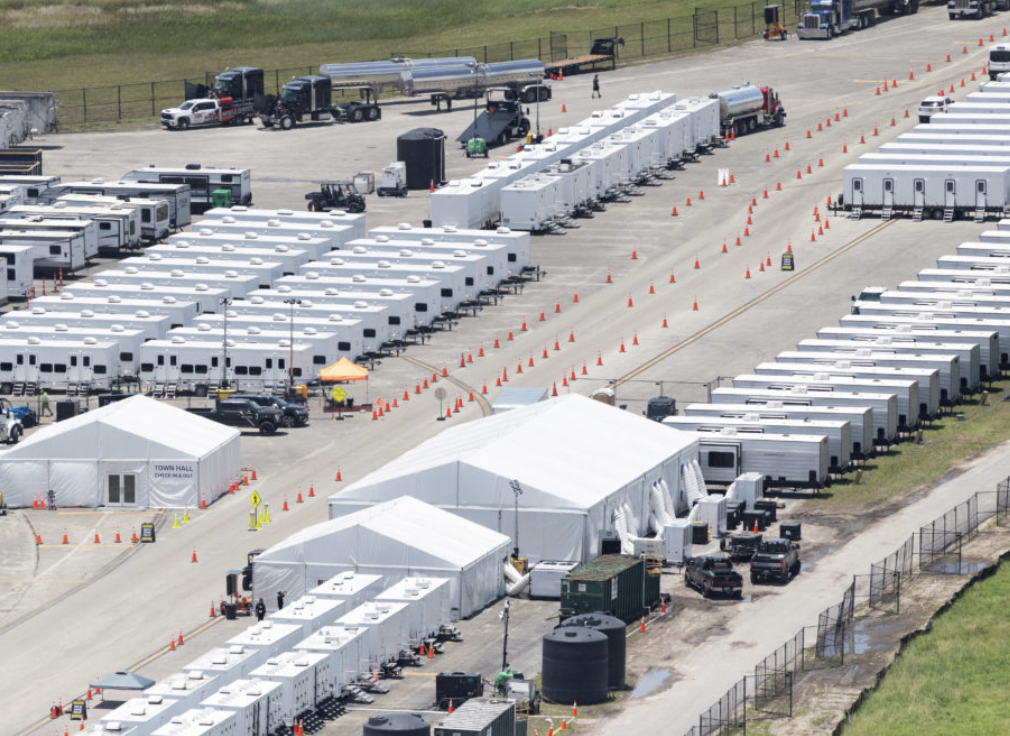 since it was under construction. In a recent interview on PBS News Weekend, Ceballos said that, while the facility is reportedly run by the Florida Department of Emergency Management, there is a lot of confusion and that a U.S. Department of Homeland Security was the one who confirmed that at least one person had been taken to a nearby hospital “with a medical emergency.” A spokesperson at HCA Healthcare, which operates Kendall Regional Hospital, confirmed getting a patient from the prison July 9.
Pedro Lorenzo Concepción, 44, is one of the detainees on hunger strike that went to Kendall Regional recently because he collapsed, his family said, adding that he sat there in handcuffs while doctors and nurses tried to get him to eat something, which he refused. Another detainee told his family that he hadn’t gotten his medication in five days — even though Florida officials say there in an on-site pharmacy.
Can we get a photo? And receipts.
This is cruel and unusual punishment — by design. Does it have to be medical neglect, too?
The Miami-Dade Health Department should have jurisdiction. It’s their job to protect public health — and last I checked, “public” includes detainees at a detention center, whether they crossed the border yesterday, arrived 30 years ago, or were born here. It has happened.
Read related: Maria Elvira Salazar’s ‘Dignity Act’ is about zero dignity and all a big act
At the very least, we need independent medical consultants to make oversight visits. They could conduct intake and emergency health assessments. They could evaluate sanitation and medical-supply infrastructure. They could recommend improvements to detainee healthcare delivery. And if whoever is in charge doesn’t want to provide access, the county health department could coordinate with legal advocates to obtain court-ordered medical inspections.
Except that legal advocates are hitting a maze of brick walls. The ACLU has filed a lawsuit because detainees have no access to their attorneys or immigration courts. Lawyers say that trying to reach their clients is like yelling into a void — no answers, no access, no decency. It’s just one more way to dehumanize these detainees and treat them like disposable bodies instead of people with rights. It’s just one more reminder that this place was never built for justice. It was built for torture.
And what have we heard from the administrator at the Miami-Dade branch of the Florida Department of Health, Yesenia Villalta (786- 336-1259 or Yesenia.villalta@flhealth.gov)? Crickets. The Florida Department of Corrections also has an inspector general. His name is Ken Sumpter (Kenneth.Sumpter@fdc.myflorida.com or 850-488-9265). Why isn’t he asking any questions? He has full access as granted by Florida Statue 944.31.
So, where is everyone? Why aren’t they demanding access? Or issuing a report? Or — at the very least — telling us if the water is drinkable and the air is breathable?
Because if 12 people are getting sick, and it’s likely a lot more, that’s not a coincidence — that’s a pattern. And patterns of medical neglect don’t go unnoticed forever. Do we have to wait for someone to die for people in charge to make healthcare a priority?
At this rate, it’s going to happen.

Independent medical access must be given to detainees at Alligator Alcatraz added by Ladra on
View all posts by Ladra →
